432 Hz vs 440 Hz: Myth, Science & Sound Healing
Oct 27, 2021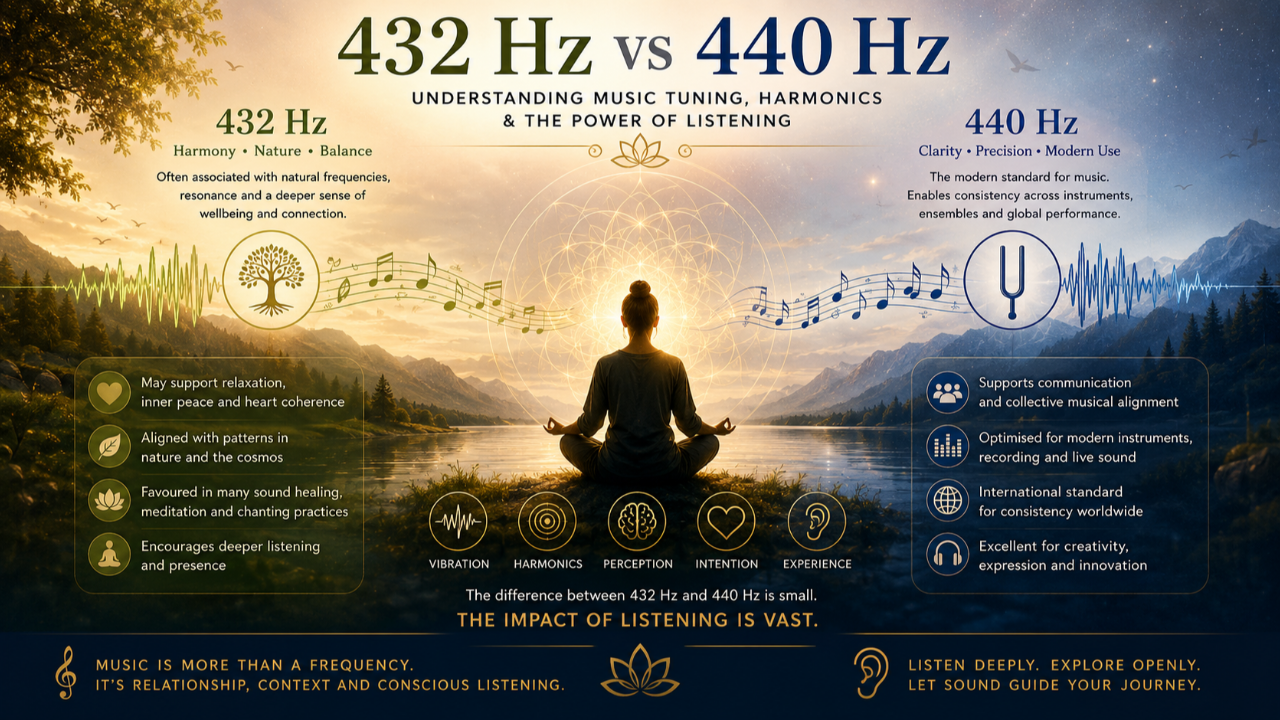
432 Hz vs 440 Hz: Myth, Science & Sound Healing
Does the tuning of music really matter?
By Nick Gent | The Mind Orchestra
Introduction
Few topics in the world of sound healing inspire as much discussion as the question: Is music tuned to 432 Hz better than music tuned to 440 Hz?
It is one of the questions I am asked most frequently by students, clients, musicians and people encountering sound healing for the first time. Spend only a few minutes searching online and you will quickly discover an extraordinary range of opinions. Some people describe 432 Hz as a more natural or harmonious tuning, while others suggest it possesses unique healing qualities or reflects patterns found throughout nature. Others argue that 440 Hz, the modern international tuning standard, is somehow artificial, harsh or even harmful. At the opposite end of the spectrum are those who dismiss the entire conversation as pseudoscience, believing there is nothing meaningful to discuss at all.
After more than twenty-five years as a musician and many years working professionally in sound healing, voice, mantra and contemplative listening, I have found myself standing somewhere between these opposing positions. My own experience has taught me that the subject is both more subtle and far more fascinating than it is often presented online.
This article is not an attempt to persuade you that one tuning system is superior to another, nor is it written to dismiss the genuine experiences people may have when listening to music tuned in different ways. Instead, my intention is to step back from the debate and explore the wider landscape of sound itself. My hope is that, by understanding a little more about acoustics, music, psychology, listening and human perception, we can begin asking richer questions than simply deciding whether one number is "better" than another.
The difference between 432 Hz and 440 Hz is only eight cycles per second. Yet sound itself exists across an unimaginably vast spectrum of vibration. Human hearing occupies only a small window within that spectrum, while the natural world continually resonates with frequencies extending far beyond our conscious perception. Every voice, every musical instrument and every sound in nature is composed not of one isolated frequency, but of countless interacting vibrations unfolding together.
When we reduce our relationship with sound to a single number, we risk overlooking the extraordinary richness of the whole orchestra.
For me, the more interesting question has gradually become something quite different. Rather than asking, "Which frequency is better?", I now find myself asking, "How do vibration, listening, biology, psychology, music and intention come together to shape human experience?" That is the journey this article explores.
Why This Question Matters
Although discussions about 432 Hz and 440 Hz often focus on musical tuning, they also invite us to explore much deeper questions about music, healing and human perception. Can music influence our wellbeing? Does changing a tuning reference alter the way music is experienced? What role do expectation, intention and personal history play in the way we listen? What does scientific research currently tell us, and where does personal experience offer insights that science is still exploring? Perhaps most importantly, how do we distinguish between measurable evidence, meaningful experience and philosophical interpretation without reducing one to the other?
These are valuable questions, and I believe they deserve curiosity rather than certainty, exploration rather than argument. Throughout this article I occasionally share my own reflections, shaped by years of working with music, meditation, mantra and sound healing. They are offered simply as one perspective among many, not as absolute truth.
If listening to music tuned to 432 Hz genuinely helps you feel calmer, more centred or more connected, then that experience has value. Equally, if you create or enjoy beautiful music tuned to 440 Hz, there is no reason to assume you are somehow participating in harmful sound simply because of the reference pitch being used. Music has always been far richer than a single number.
My invitation is simply this: approach sound with curiosity rather than dogma. Listen carefully. Explore openly. Be willing to question your assumptions while remaining receptive to new discoveries. The world of sound is rarely divided into frequencies that are wholly good or wholly bad. Like music itself, reality is usually far richer, more subtle and far more beautiful than that.
What is Hertz?
Before we can meaningfully compare 432 Hz and 440 Hz, it helps to understand what Hertz actually measures.
A Hertz (Hz) is simply a unit of frequency. It describes how many complete vibrations occur every second. If something vibrates once every second, it has a frequency of 1 Hz. If it vibrates ten times every second, its frequency is 10 Hz. One hundred vibrations every second equals 100 Hz, while four hundred and forty vibrations every second equals 440 Hz.
That is all Hertz measures. It is simply a way of counting how many cycles occur over time. It does not tell us whether a sound is beautiful or unpleasant. It cannot measure emotional impact, artistic expression or healing potential. Hertz is a measurement of frequency, not of meaning.
This distinction is important because many discussions online unintentionally assign qualities to numbers that Hertz itself cannot describe. A frequency is simply a measurement. Our experience of music, however, is shaped by far more than numbers alone. Melody, harmony, rhythm, timbre, dynamics, memory, expectation and emotion all contribute to the way we experience sound. Frequency is only one thread in a much larger tapestry.
Sound Exists Within an Enormous Spectrum
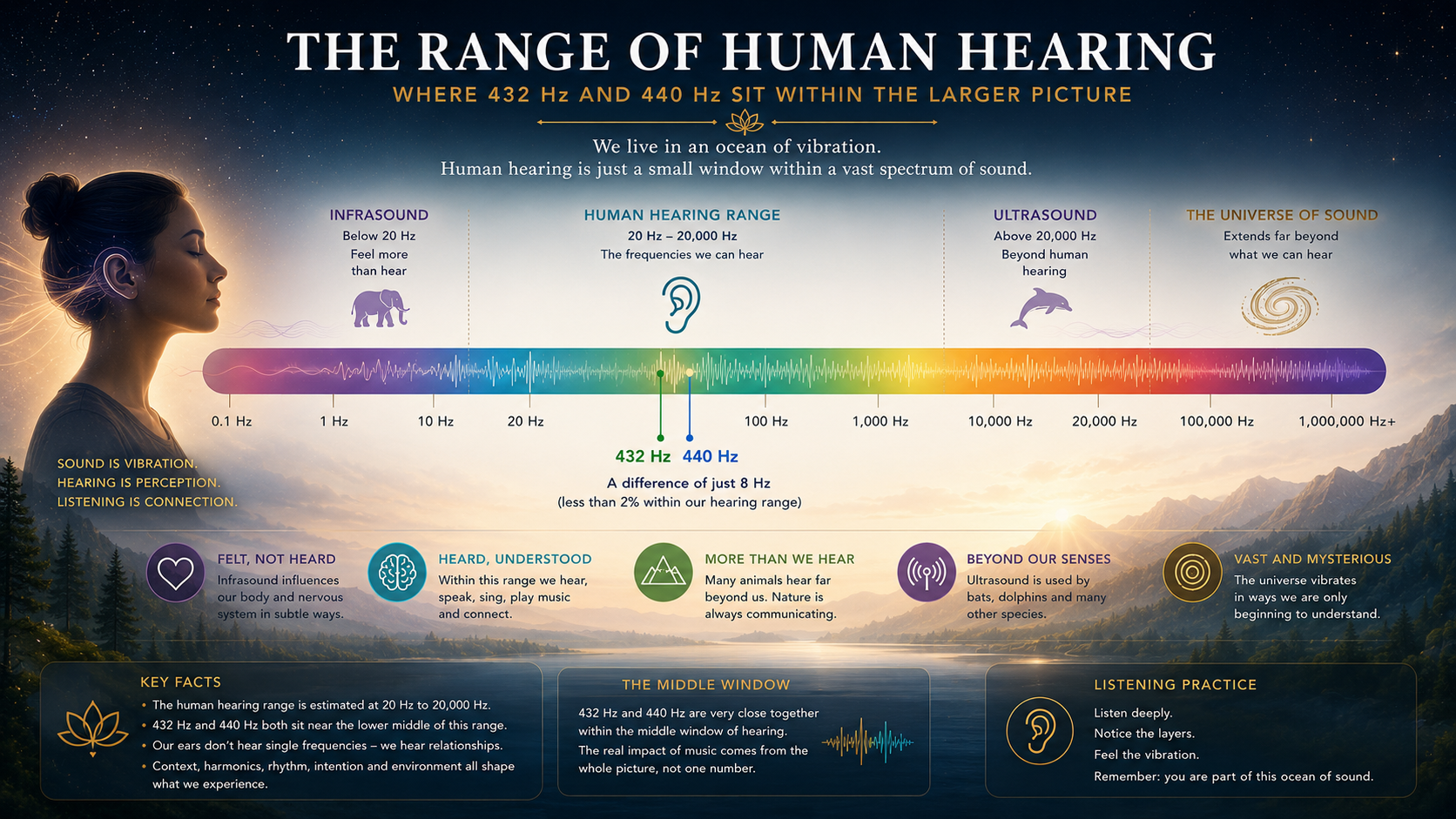
Human hearing typically extends from around 20 Hz to approximately 20,000 Hz, although this range varies considerably with age and from one individual to another. You can explore this for yourself using a simple tone generator. As you gradually move lower and higher through the frequencies, there comes a point where the sounds seem to disappear. Yet they have not ceased to exist. The vibrations are still present; they have simply moved beyond the limits of human hearing.
This is an important reminder that the world does not stop vibrating simply because we can no longer perceive it. Our hearing represents only one small window into a far larger acoustic universe. Beyond the boundaries of our perception exists an extraordinary landscape of vibration that continues regardless of whether we are aware of it.
Other species experience this world very differently. Dolphins, for example, can detect frequencies far beyond the upper limits of human hearing, allowing them to navigate, communicate and explore their environment using ultrasonic sound. Many other animals also perceive aspects of the acoustic world that remain completely hidden from us.
I find this perspective both humbling and inspiring. The soundscape we experience each day is only a tiny fragment of everything that is happening around us. Countless vibrations pass through the world continuously, weaving together into an immense symphony that extends far beyond the limits of our senses.
When viewed within this vast spectrum, the difference between 432 Hz and 440 Hz begins to find its proper context. Eight cycles per second is a relatively small adjustment within an extraordinarily rich world of vibration. That does not automatically mean it is insignificant, nor does it mean it should be dismissed. Rather, it reminds us to understand these frequencies as part of a much larger whole, where relationships, patterns and context are often just as important as the individual numbers themselves.
What Do 432 Hz and 440 Hz Actually Mean?
One of the biggest misunderstandings surrounding this discussion is the assumption that all of the music somehow becomes either 432 Hz or 440 Hz. In reality, this isn't what those numbers represent.
The figures 432 Hz and 440 Hz refer to one specific note: the A above middle C, known as A4. This note serves as the reference pitch used to tune most modern Western instruments. Before a concert begins, the oboe traditionally plays an A, and the rest of the orchestra tunes their instruments in relation to that single note.
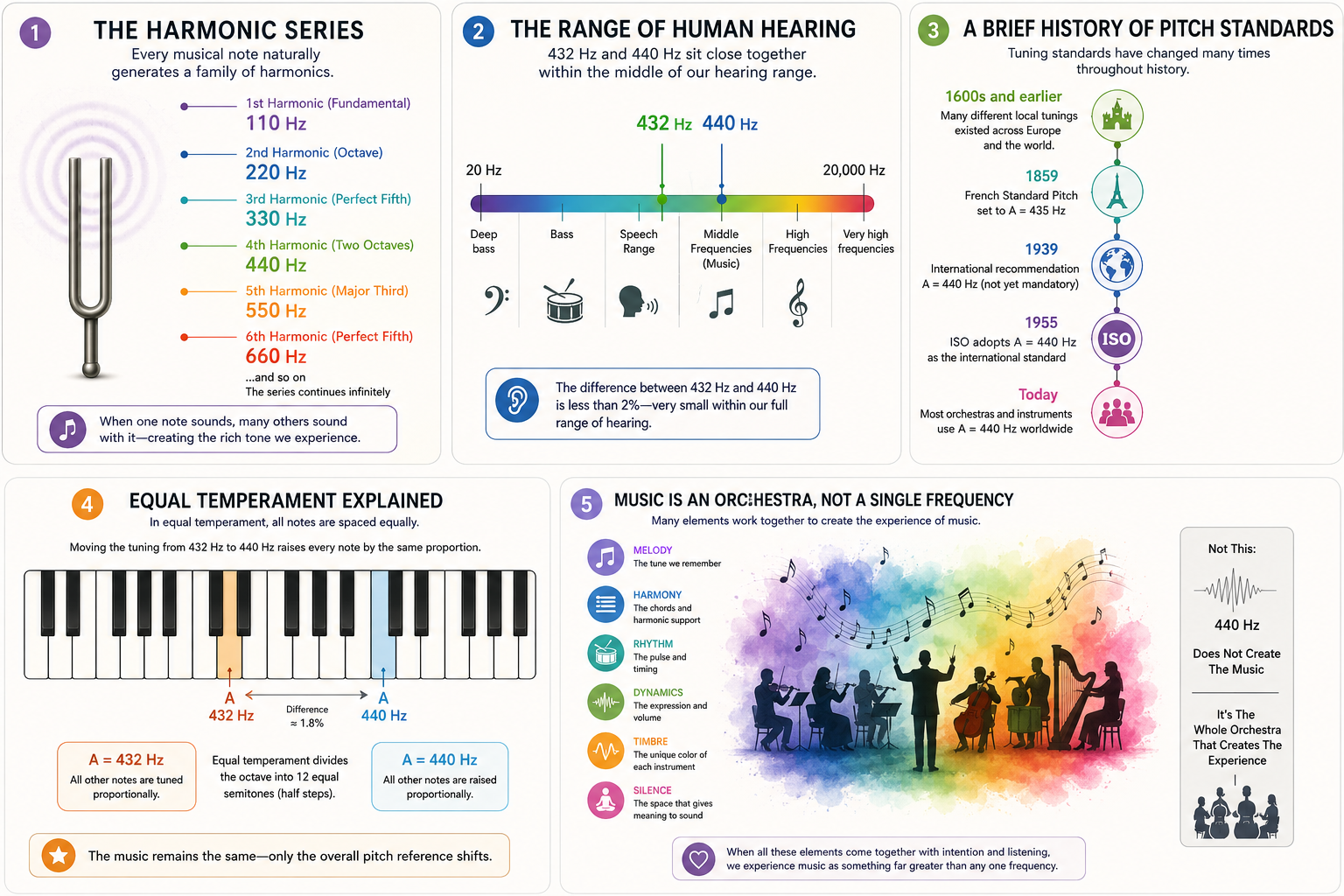
If the orchestra tunes to A = 440 Hz, every other note is adjusted proportionally around that reference. If the orchestra instead tunes to A = 432 Hz, the entire instrument is lowered slightly in pitch, but the musical relationships remain exactly the same. The melodies are unchanged, the chords are unchanged, the intervals between the notes are unchanged, and the overall emotional character of the composition remains largely intact. What changes is simply the overall pitch at which the music is performed.
A helpful way to imagine this is to think of a painting hanging on a gallery wall. Lowering it by a few centimetres does not alter the artwork itself. The colours, composition and meaning remain exactly the same; only its position has shifted. In much the same way, changing the reference pitch from 440 Hz to 432 Hz gently lowers the entire musical landscape without changing the relationships that give the music its identity.
This is an important distinction because music is recognised primarily through its relationships rather than its absolute frequencies. Most people can recognise a familiar song whether it is sung by a child, a choir or a concert pianist playing in a different key. The melody remains recognisable because the intervals between the notes stay the same, even when the overall pitch changes. Understanding this principle provides an important foundation for everything else we will explore throughout this article.
Music Is Made from Relationships
One of the most important ideas in this entire discussion is that music is not built from isolated frequencies. It is built from relationships.
When we hear a major chord, we are not responding to three independent frequencies in isolation. We are responding to the mathematical relationships between those frequencies and the way they interact with one another. Likewise, when we recognise a familiar melody, we are rarely remembering the absolute frequency of every note. Instead, we remember the pattern of intervals, the distances between the notes, that give the melody its unique identity.
This is why someone can sing "Happy Birthday" in almost any key and we still recognise it immediately. The overall pitch may have changed, but the relationships between the notes remain intact. The melody survives because its internal architecture has been preserved. The tuning reference has shifted, but the music itself has not.
This simple observation is one of the reasons I hesitate whenever people suggest that changing a single reference frequency completely transforms the nature of a piece of music. Music is far more sophisticated than that. Its emotional power does not arise from one isolated vibration, but from the countless interactions between melody, harmony, rhythm, dynamics, timbre and silence.
As both a musician and a sound healer, this is perhaps the most important point I can make. Music is not made from individual frequencies. Music is made from relationships between frequencies. Harmony is relationship. Melody is relationship. Rhythm is relationship. Counterpoint is relationship. Even silence gains its meaning through its relationship with sound.
This principle extends far beyond music itself. The beauty of birdsong is not contained within a single note, nor is the sound of wind through a forest one continuous frequency. Ocean waves are not a single vibration, and human speech is never one pure tone. Everywhere we look, life expresses itself through countless vibrations continuously interacting, overlapping and responding to one another.
For me, this is where the conversation moves beyond the debate about 432 Hz and 440 Hz. To focus exclusively on one frequency is a little like trying to understand an ancient woodland by studying a single leaf. The leaf certainly matters, but it cannot explain the living relationships between the trees, the soil, the fungi, the birds, the insects, the wind and the changing seasons. It is the ecology of the forest that gives it life.
Music is much the same. Every note exists within a wider acoustic ecosystem, where each vibration influences every other. When we begin listening in this way, our attention naturally shifts from searching for one "perfect" frequency towards appreciating the extraordinary web of relationships that gives music its depth, beauty and expressive power.
Perhaps this is also true of ourselves. We are not isolated beings moving through the world alone. We exist through relationships: with our bodies, with one another, with nature, with memory, with silence and with sound. In that sense, the deepest lesson music offers may not be about finding one ideal frequency at all. It may be about rediscovering the harmony that emerges when many different voices learn to belong together.
A Brief Thought Experiment
Imagine attending two piano recitals on consecutive evenings. On the first night, a pianist performs one of Debussy's masterpieces on a beautifully prepared piano tuned to A = 440 Hz. The following evening, another equally accomplished pianist performs exactly the same piece on an identical instrument, this time tuned to A = 432 Hz. Both musicians possess exceptional technique. Both perform with sensitivity, expression and artistry. Both communicate emotion and leave their audience deeply moved.
Would one performance suddenly become healing while the other became harmful?
Personally, I find that difficult to believe.
What an audience experiences is shaped by countless interacting elements. The composition itself, the harmony, rhythm, dynamics, phrasing, touch and timing all influence the emotional character of the performance. So too do the acoustics of the room, the quality of the instrument, the skill of the performer and the unique experiences each listener brings with them. Memory, expectation, mood, culture and personal associations all become part of the listening experience.
Changing the tuning reference is undoubtedly one variable within that rich tapestry, and it may subtly influence the character of the music. However, it is only one variable among many. To isolate it from everything else and suggest that it alone determines whether music is healing or harmful risks overlooking the extraordinary complexity of both music and human perception.
For me, this is one of the reasons the debate is so fascinating. It encourages us to look beyond individual frequencies and towards the much richer question of how sound, performance, environment and the listener come together to create musical experience. Perhaps it is within that meeting, rather than within one number alone, that music reveals its deepest power.
The Orchestra Is Greater Than One Instrument
One of the metaphors I return to again and again is that of the orchestra. An orchestra is beautiful not because every instrument plays the same note, but because many different voices coexist in harmony. Violins, cellos, flutes, French horns, percussion and countless other instruments each occupy their own unique range, colour and role, yet together they create something far greater than any one of them could achieve alone. No single instrument creates the symphony; it is the relationship between them that gives the music its depth, movement and emotional power.
I believe sound works in much the same way. No single frequency creates the experience of music. At every moment our nervous system is responding to thousands of simultaneous relationships. The brain is recognising patterns, the body is responding physiologically, our emotions are colouring perception and our imagination is constructing meaning from everything we hear. Music emerges through the conversation between all of these elements, each one influencing the others in subtle and often immeasurable ways.
Perhaps that is why I have always found it difficult to reduce sound healing to a single frequency. Such an approach feels rather like trying to understand an orchestra by listening to only the violins, or attempting to appreciate a painting by looking at just one colour. Important though each individual element may be, it is the relationships between them that create the whole.
For me, this is one of the deepest lessons music has to offer. The orchestra is always greater than one instrument. The spectrum is always greater than one frequency. Wholeness is always greater than one part. Whether we are listening to music, exploring sound healing or simply paying attention to the world around us, it is often within the harmony of many voices, rather than the perfection of one, that the greatest beauty is found.
Has Music Always Been Tuned to 440 Hz?
One of the assumptions often repeated online is that 440 Hz has always been the universal tuning standard, or that it was somehow imposed upon music as though there had once been a single "correct" frequency for everyone to follow. The historical reality is both far more complex and, in my opinion, far more fascinating.
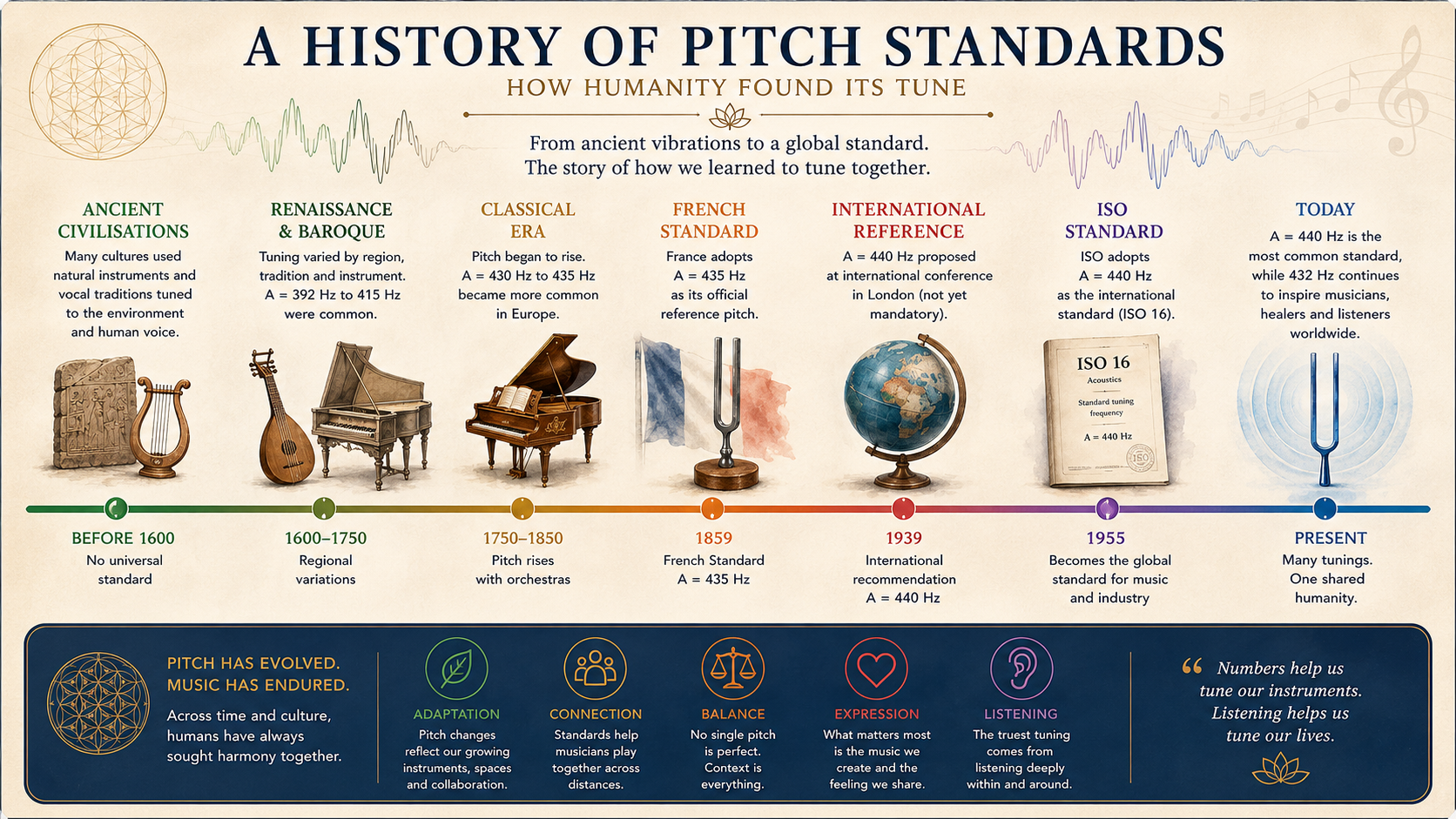
For most of human history there was no universal tuning standard at all. An organ built in Venice might have been tuned quite differently from one built in London, and a violinist travelling between cities could easily discover that every church, royal court or orchestra used its own preferred reference pitch. In some cases the differences were so significant that instruments needed to be retuned or even rebuilt before they could be played together.
Historical pitch standards varied enormously. Some were noticeably lower than today's A = 440 Hz, while others were considerably higher. If you had travelled across Europe several centuries ago, you might have encountered dozens of different tuning standards, each regarded as perfectly normal within its own region. There was no single international agreement, only a rich diversity of musical traditions that reflected local craftsmanship, culture and performance practice.
This history reminds us that tuning has never been static. It has continually evolved alongside the instruments people built, the music they composed and the practical needs of performers. The modern reference of A = 440 Hz is simply the latest chapter in a much longer story, not the beginning of it. Understanding this historical context helps us appreciate that musical tuning has always been a living tradition, shaped by human creativity and collaboration rather than by one fixed and timeless standard.
Why Did 440 Hz Become the International Standard?
One of the most common claims made online is that A = 440 Hz was chosen for mysterious or even sinister reasons. Having explored the history of musical tuning, I believe the real story is considerably less dramatic and, in many ways, far more interesting. Rather than being the result of a hidden agenda, the adoption of 440 Hz was primarily a practical solution to a growing international problem.
For centuries there had been no single tuning standard. Every region, cathedral, orchestra and instrument maker often worked with their own preferred reference pitch, meaning that musicians travelling from one city to another frequently encountered unexpected tuning differences. An instrument that sounded perfectly in tune in one location might seem noticeably sharp or flat in another. Performers simply adapted because they had little choice, but as music became increasingly international this lack of consistency created growing practical difficulties.
During the nineteenth and early twentieth centuries orchestras became larger, international travel became easier and recorded music began reaching wider audiences. Instrument manufacturers wanted to build instruments that could be sold around the world, opera singers needed consistency from one venue to the next, conductors wanted orchestras from different countries to perform together without extensive retuning, and recording studios also benefited from everyone working from the same reference pitch. Gradually, it became clear that agreeing on a common standard would make musical collaboration significantly easier.
The important word here is agreement, not perfection. A tuning standard is fundamentally a convention, much like agreeing that a metre contains one hundred centimetres or that a kilogram represents a particular weight. These standards exist to provide consistency and shared understanding, not because one measurement possesses some inherent superiority over another.
Throughout the early twentieth century a number of different reference pitches were proposed and discussed internationally. Some countries favoured slightly lower standards, while others preferred slightly higher ones. Eventually A = 440 Hz emerged as the most widely accepted compromise and, in time, became the international reference pitch. The decision was administrative rather than philosophical. It was made to improve consistency between musicians, orchestras and instrument makers, not because anyone claimed that 440 Hz possessed unique healing properties or that every other tuning system was somehow incorrect.
Seen in this light, 440 Hz is best understood as a shared musical language rather than a declaration of perfection. It allows musicians from different traditions and different parts of the world to perform together with confidence, while still leaving plenty of room for composers, performers and ensembles to explore alternative tuning systems whenever artistic or historical considerations call for them.
Music Has Never Belonged to One Number
One of the most fascinating aspects of musical history is that tuning has never stood still. It has continually evolved alongside the instruments people built, the music they composed and the cultures in which they lived. Even today, there is no single approach that every musician follows. Baroque ensembles often perform at around A = 415 Hz, many Classical ensembles favour approximately A = 430 Hz, while most modern orchestras use A = 440 Hz as their standard reference. Some European orchestras regularly tune slightly higher still, often around A = 442 Hz or 443 Hz, because conductors and musicians enjoy the increased brilliance, projection and energy that these slightly higher pitches can bring to an orchestral performance.
Outside the world of Western classical music, the picture becomes even richer. Film composers occasionally choose alternative reference pitches for artistic reasons, while traditional instruments and musical cultures from around the world frequently employ tuning systems that bear little resemblance to modern Western equal temperament. Indian classical music, Arabic maqam, Indonesian gamelan and countless other musical traditions each possess their own unique approaches to pitch, intonation and musical expression, reminding us that there has never been just one way to organise sound.
I find this diversity both beautiful and deeply reassuring. It reminds us that music has never belonged to one number, one standard or one fixed way of thinking. It is a living art that has continually adapted to different cultures, instruments, technologies and creative imaginations. Every generation inherits musical traditions, reshapes them and passes them on, adding its own voice to an ever-evolving conversation.
Perhaps that is one of music's greatest strengths. It is not static. It is alive. It grows, responds and transforms alongside humanity itself, continually finding new ways to express the richness of human experience. Rather than searching for one perfect tuning that all music must obey, we might instead celebrate the remarkable diversity through which music has always flourished.
Where Did the Modern 432 Hz Movement Come From?
The modern popularity of 432 Hz has grown largely through books, documentaries, websites, social media and online discussions over the past two decades. During that time, many musicians, sound healers and listeners have shared genuinely meaningful personal experiences after listening to music tuned to 432 Hz. Some describe it as feeling warmer, softer or more relaxing, while others report little or no noticeable difference. Like many aspects of music, individual experience varies considerably from one person to another.
Alongside these personal accounts, a number of writers and researchers have explored possible connections between 432 Hz and subjects such as mathematics, astronomy, sacred geometry, ancient civilisations and the natural world. Some of these ideas are thoughtful and invite interesting philosophical questions. Others remain speculative, while some historical claims have been repeated so frequently online that they are often accepted as fact despite there being little reliable historical documentation or reproducible scientific evidence to support them.
As these ideas spread across the internet, they naturally became simplified. Nuanced discussions were often reduced to short statements or memorable slogans that were easy to share. Possibilities gradually became certainties, and questions that originally invited exploration were sometimes presented as established fact. This is one of the challenges of discussing complex subjects in the age of social media, where subtlety is often lost in favour of certainty.
None of this means that the personal experiences people report when listening to music tuned to 432 Hz are somehow invalid. On the contrary, those experiences are often sincere and meaningful. However, it is important to distinguish between different ways of understanding the world. Personal experience, historical evidence, scientific research and philosophical interpretation each offer valuable insights, but they answer different kinds of questions. Confusing one with another can easily lead to misunderstanding, even when everyone's intentions are entirely genuine.
For me, this distinction is one of the most important themes in the whole discussion. History helps us understand what happened. Science helps us investigate how things work. Philosophy invites us to explore meaning, while personal experience tells us how something feels. None of these perspectives is sufficient on its own, yet together they provide a richer and more balanced understanding of our relationship with sound. Rather than placing them in opposition, I believe we benefit most when we allow each to contribute its own voice to the conversation.
The Danger of Certainty
One of the reasons I wanted to write this article is that, over the years, I have watched the conversation around 432 Hz become increasingly polarised. At one extreme are those who insist that 432 Hz possesses extraordinary healing powers and that 440 Hz is inherently harmful. At the other are those who dismiss anyone interested in alternative tuning systems as misguided or unscientific. Personally, I find neither position particularly satisfying.
Music has always invited exploration rather than certainty. It encourages curiosity, experimentation and, above all, attentive listening. It seems unlikely to me that something as profound, expressive and deeply human as music could be fully explained by a single number. Equally, I think it would be unwise to dismiss the lived experiences of musicians and listeners simply because current scientific research has not yet explained every aspect of musical perception.
One of the greatest strengths of both music and science is that they leave room for discovery. Science continues to refine its understanding as new evidence emerges, while musicians continually uncover fresh ways of expressing emotion, beauty and meaning through sound. Neither discipline stands still, and both are enriched by open-minded enquiry rather than rigid certainty.
For me, the healthiest position lies somewhere between unquestioning belief and automatic dismissal. It is a place where we remain curious enough to explore new ideas, yet careful enough to distinguish between observation, evidence and interpretation. We can appreciate personal experience without presenting it as universal proof, and we can value scientific research without imagining that it has already answered every meaningful question about music or consciousness.
As musicians, sound healers and listeners, I believe we have permission to remain curious. We do not have to choose between scepticism and wonder. We can listen carefully, question honestly, explore thoughtfully and allow our understanding to deepen over time. In many ways, that spirit of enquiry is at the heart of both music and sound healing, and perhaps it is the most valuable lesson this discussion has to offer.
Science, Experience and Humility
Science is one of humanity's greatest achievements. It provides us with powerful methods for observing the world, asking questions, testing ideas and refining our understanding as new evidence becomes available. One of its greatest strengths is that it is never truly finished. Conclusions are continually re-examined, theories are refined and long-held assumptions are sometimes revised in the light of new discoveries. This willingness to question itself is one of the reasons science continues to deepen our understanding of the natural world.
At the same time, personal experience also has an important place in our lives. If listening to a particular piece of music leaves you feeling calmer, more peaceful or deeply moved, that experience is entirely real. It forms part of your relationship with music and may influence your wellbeing in meaningful ways. Where science asks, "What did you experience?", it also asks a second question: "Can we demonstrate that this particular effect was reliably caused by this specific factor?" These are related questions, but they are not the same question.
For me, these perspectives are not in conflict. They are complementary. Science helps us understand mechanisms by investigating how and why things happen, while personal experience helps us understand meaning by revealing how those experiences are felt and interpreted in our own lives. One seeks patterns that can be tested and repeated; the other explores the richness of individual human experience. Both have something valuable to contribute.
Music has always existed somewhere between these two ways of knowing. It can be analysed through acoustics, neuroscience and psychology, yet it can also move us in ways that are deeply personal, emotional and difficult to measure. A melody may be described mathematically, but the feeling it awakens within us belongs to the uniquely human experience of listening.
Perhaps that is why I believe humility is so important in conversations like this. Science continues to ask better questions, while music continues to reveal new depths each time we truly listen. Rather than forcing one perspective to replace the other, we can allow both to inform our understanding. In doing so, we remain open to evidence without losing our sense of wonder, and open to personal experience without mistaking it for universal proof. For me, that balance is where the most meaningful exploration of sound begins.
How Do We Actually Experience Sound?
Up to this point we have explored tuning standards, musical history and the origins of the modern discussion surrounding 432 Hz. These subjects provide useful context, but they also invite a much more fundamental question. What actually happens when we experience sound? Once we begin to explore that question, the conversation becomes far richer than simply comparing one reference pitch with another.
Most of us naturally think of sound as something we experience through our ears, and that is certainly true. Yet hearing is only one part of a much larger story. At its most fundamental level, sound is vibration. Whenever an object vibrates, it transfers energy into the surrounding air, water or solid material, creating waves that travel outward until they encounter something else.
Sometimes those vibrations reach the delicate structures of the ear, allowing us to perceive them as sound. At other times they are felt through the skin, the bones or the entire body. Anyone who has stood beside a large drum, placed a hand on a resonating instrument or felt the low frequencies of music through the floor will know that sound can be experienced as much through sensation as through hearing. Vibration is not confined to one pathway; it engages us in several ways at once.
Our relationship with sound is therefore far more than an auditory experience. It is embodied, physical and deeply connected to the way our nervous system interacts with the world. At the same time, sound can evoke emotions, awaken memories, influence attention and shape our psychological experience. For many people it also carries personal, cultural or spiritual meaning, becoming woven into ritual, identity and human connection.
When we begin to appreciate sound in this broader way, it becomes clear that reducing it to a single frequency tells only a small part of the story. Sound is not simply something we hear. It is something we encounter with our whole being, and perhaps that is one of the reasons it has such a remarkable capacity to move us, communicate with us and accompany us throughout every stage of our lives.
Hearing Begins in the Ears, but Finishes in the Brain
Although we often think of hearing as something that happens in our ears, the ears are really only the beginning of the journey. Their role is to collect vibrations from the surrounding environment and channel them into the inner ear, where thousands of tiny sensory hair cells within the cochlea convert those vibrations into electrical signals. These signals then travel along the auditory nerve to the brain, where the remarkable process we recognise as hearing truly begins.
The brain does far more than simply receive sound. It actively interprets and constructs our experience of listening. In fractions of a second it identifies familiar voices, separates speech from background noise, recognises melodies, estimates the direction from which sounds are coming and anticipates rhythmic patterns. It also fills in missing information, links sounds to memories and emotions, and helps us recognise the unique character of different instruments and voices. Every moment we listen, our nervous system is performing an extraordinary series of interpretations, most of which take place entirely outside our conscious awareness.
This means that listening is not a passive process but an active collaboration between the external world and the brain. We do not simply record sound like a microphone; we continually interpret, organise and give meaning to what we hear. Our expectations, memories, emotions, attention and previous experiences all become part of that process, subtly shaping the way music is perceived.
I find this perspective both fascinating and important because it reminds us that hearing is far more than the detection of frequencies. Every musical experience is a meeting between vibration and consciousness. The physical properties of sound certainly matter, but so too does the extraordinary way our brains transform those vibrations into melody, emotion, memory and meaning. It is within that relationship, between the measurable world of acoustics and the deeply personal world of human perception, that much of the mystery and beauty of music resides.
Sound Is Always Meeting a Listener
One of the most remarkable aspects of music is that the same piece can evoke completely different experiences in different people. Two individuals may sit side by side, listening to exactly the same performance under exactly the same conditions, yet each leaves with a unique emotional impression. One person may be moved to tears, while another feels peaceful but otherwise unchanged. One listener is transported back to childhood, another recalls a time of grief or loss, while someone else simply delights in the rhythm, harmony or craftsmanship of the performance.
The music itself has not changed. What has changed is the person listening.
Every one of us brings an entire lifetime of experiences into every moment of listening. Memory, expectation, culture, physiology, attention, mood, personal history, environment, beliefs and intention all shape the way we perceive sound. These influences are often subtle and largely unconscious, yet they play a profound role in determining how music is experienced and what meaning we draw from it.
This is one of the reasons I find music so endlessly fascinating. A piece of music is never encountered in isolation; it is always received by a unique human being with their own story, their own nervous system and their own way of making sense of the world. Listening is therefore not simply the passive reception of sound waves. It is an active meeting between vibration and consciousness, where the physical world of acoustics meets the inner landscape of memory, emotion and awareness.
Perhaps this is why music has such an extraordinary capacity to connect us. Although we may hear the same sounds, each of us discovers something slightly different within them. In that sense, every act of listening is both universal and deeply personal, reminding us that sound is not merely something that reaches our ears, but something that enters into relationship with who we are in that very moment.
We Do Not Hear Individual Frequencies
One of the most common misconceptions about sound is the idea that we experience isolated frequencies. In reality, this almost never happens. Nearly every sound we encounter is made up of many frequencies occurring simultaneously, interacting with one another in complex and constantly changing ways.
Consider a single note played on a piano. Although we often describe it as one note, it is not a single frequency. The same is true of a violin, a singing bowl, a bird calling at dawn, the sound of rainfall or even your own speaking voice. Each produces not just one vibration but an intricate family of related frequencies known as harmonics or overtones. These additional frequencies give every sound its richness, depth and unique character.
This changes the way we think about listening. Whenever we hear what appears to be a single note, we are in fact hearing a beautifully organised spectrum of vibrations unfolding together. The fundamental frequency provides the pitch we recognise, while the harmonics shape the tone, colour and personality of the sound. Without them, a piano would no longer sound like a piano, nor would a human voice carry the qualities that allow us to recognise the people we know.
For me, this is one of the most remarkable aspects of acoustics. Every note contains far more than first meets the ear. Rather than existing as an isolated point, it behaves more like a living community of vibrations, each contributing something to the whole. In that sense, every sound is a small acoustic ecosystem, where countless relationships combine to create the richness of the world we hear.
Understanding this principle is essential to the discussion of 432 Hz and 440 Hz, because it reminds us that music is never built from one frequency alone. Every note, every instrument and every voice is already a tapestry of interacting vibrations, and it is those relationships that give music its extraordinary depth and expressive power.
Harmonics: Why No Sound Exists Alone
If there is one idea I hope remains with you after reading this article, it is this: no sound exists in isolation. Every sound we hear belongs to a much larger family of vibrations, each interacting with the others in ways that give music its richness, colour and expressive depth. This simple principle lies at the heart of acoustics, instrument design and music itself. For me, it is also one of the most beautiful insights available to anyone interested in sound healing.
Imagine gently plucking a guitar string. At first it appears to produce a single note, but something far more remarkable is taking place. The entire string vibrates as one, creating the fundamental pitch that we recognise most easily. At exactly the same time, however, different sections of the string begin vibrating independently. It vibrates in halves, then in thirds, then in quarters, fifths, sixths and many other divisions, all simultaneously. Each of these patterns of vibration generates an additional frequency known as a harmonic or overtone. Together they form what musicians and acousticians call the harmonic series.
Every musical instrument behaves in this way. A singing bowl, a bell, a violin, a piano, a tuning fork and the human voice all produce their own unique blend of harmonics. Even beyond the world of music, the same principle can be found throughout nature. A bird calling at dawn, wind moving through the branches of a tree, ocean waves breaking along the shore or the gentle rustling of leaves all produce complex patterns of interacting vibrations rather than single, isolated frequencies.
This is one of the reasons the natural world sounds so rich and alive. We are almost never listening to one frequency alone. Instead, we are immersed in intricate layers of sound, where countless vibrations overlap, reinforce one another and continually evolve. Every note carries within it an entire landscape of relationships, and it is these relationships that give each instrument, each voice and each environment its distinctive character.
For me, the harmonic series offers something more than a fascinating piece of acoustics. It provides a way of thinking about music itself. Harmony does not emerge from one perfect frequency but from the interaction of many frequencies working together. Every note contains the seeds of relationship, and every sound participates in something larger than itself. In that sense, nature rarely produces isolated tones. Nature produces patterns, relationships and living fields of vibration, continually reminding us that the beauty of sound lies not in one frequency alone, but in the remarkable conversation between many.
One Note Becomes Many
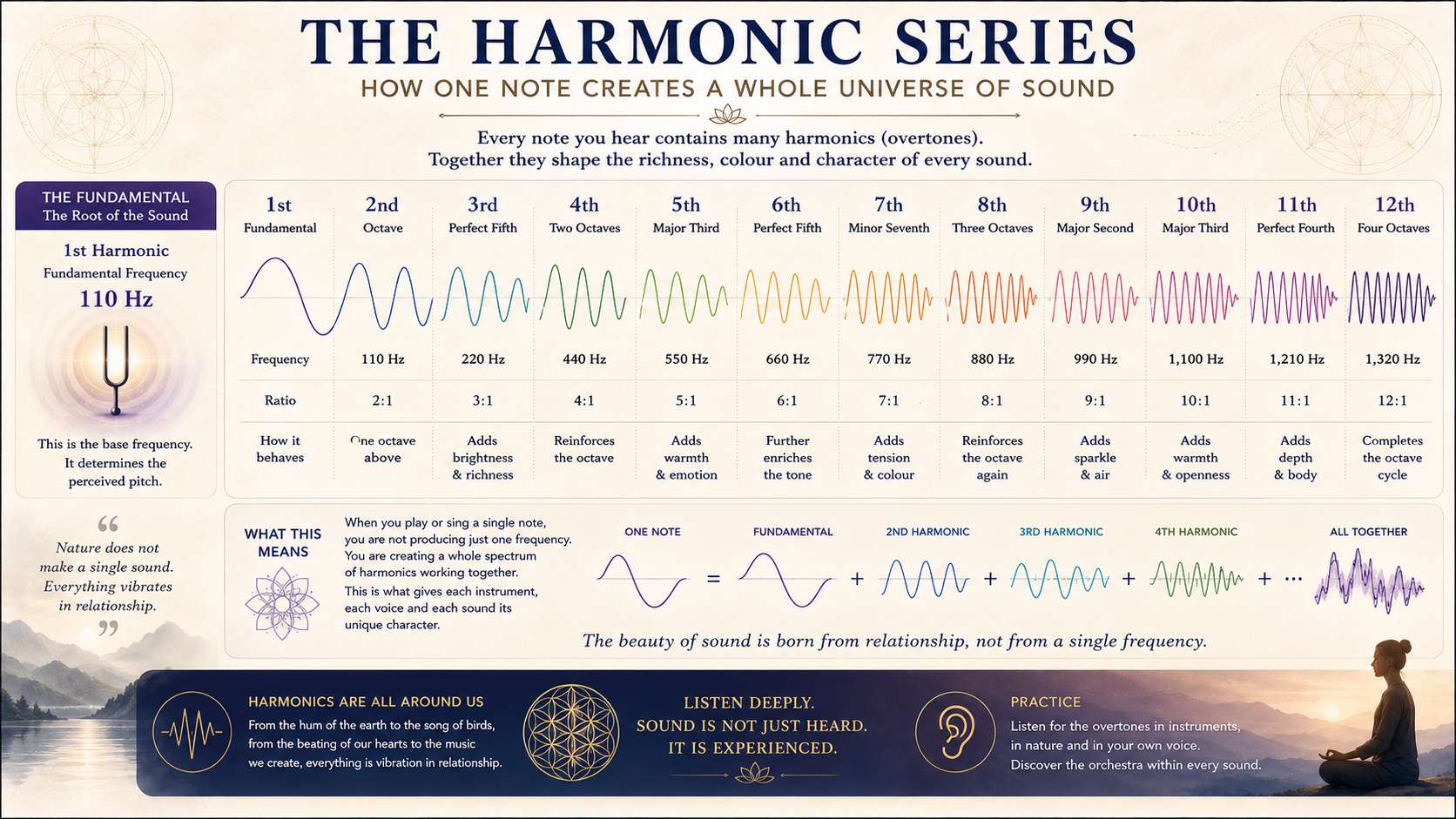
To appreciate just how rich a single sound can be, imagine singing a note with a fundamental frequency of 110 Hz. At first glance, it may seem as though you are producing only one vibration, but in reality something far more remarkable is happening. Alongside that fundamental note, your voice naturally generates a whole family of related harmonics. The second harmonic appears at approximately 220 Hz, the third at 330 Hz, the fourth at 440 Hz, followed by 550 Hz, 660 Hz and many more continuing far beyond what we consciously perceive.
One detail is particularly fascinating. Without deliberately trying to produce 440 Hz, without tuning your voice to 440 Hz and without even thinking about that frequency, it appears naturally as one of the harmonics generated by a voice with a 110 Hz fundamental. This is not unusual or exceptional; it is simply the way vibrating systems behave. Harmonics are not added afterwards. They arise spontaneously as an inherent property of the physics of vibration.
The same principle can be observed in the human voice. Earlier we noted that the fundamental speaking frequency of a typical adult male often lies somewhere between approximately 85 Hz and 155 Hz, while many adult women speak between around 165 Hz and 255 Hz. Yet the frequency we recognise as someone's voice is only the foundation. Above that fundamental unfolds an intricate architecture of harmonics, each contributing to the unique quality of the sound.
These harmonics are what give every voice its individual character. They create the warmth, brightness, richness and texture that allow us to recognise family members, friends or favourite singers after hearing only a few words. If the human voice consisted of a single isolated frequency, we would all sound remarkably similar. Instead, every person possesses a distinctive vocal fingerprint shaped by the unique relationships between many frequencies occurring simultaneously.
For me, this illustrates one of the most beautiful truths about sound. Even what appears to be a single note is never truly alone. Every vibration carries within it a hidden world of relationships, unfolding naturally according to the laws of acoustics. Once we begin listening with this understanding, it becomes difficult to think of music as isolated frequencies. Instead, we begin to hear it for what it has always been: a living tapestry of interconnected vibrations, each contributing to the richness of the whole.
Why This Matters
Understanding the harmonic series changes the way we think about the relationship between frequencies. If ordinary speech, singing and musical instruments naturally generate 432 Hz, 440 Hz and countless other frequencies as part of their normal behaviour, it becomes increasingly difficult to argue that one isolated frequency is inherently beneficial while another is inherently harmful. The physics of sound does not suggest that vibrating systems selectively favour one frequency while rejecting another. Instead, they produce rich families of related vibrations that coexist as part of a much larger whole.
This is one of the reasons I find the natural world such an inspiring teacher. Nature does not appear to divide sound into "good" and "bad" frequencies. Rather, it embraces the entire spectrum, continually generating intricate relationships between countless vibrations. Every sound we encounter, whether in music or in the environment, is the product of many frequencies interacting simultaneously rather than one frequency existing alone.
Every musical instrument illustrates this beautifully. Strike middle C on a piano and, although we describe it as a single note, acoustic analysis reveals an entire forest of harmonics extending far above the fundamental frequency. The same is true of a cello, a gong, a crystal singing bowl, a drum, a bamboo flute and the human voice. Each produces its own distinctive harmonic landscape, shaped by the physical properties of the instrument and the way it vibrates.
This also explains why two instruments can play exactly the same written note while sounding completely different. A violin and a flute may perform the same pitch, yet no listener would confuse one for the other. The fundamental frequency tells us what note is being played, but the harmonic structure tells us who is speaking. It is these complex relationships between frequencies that create the unique colour, warmth and personality that we recognise as timbre.
For me, this is one of the most profound lessons that acoustics has to offer. Music is not built from isolated frequencies competing with one another. It is woven from relationships, where every vibration contributes to the richness of the whole. Once we begin listening in this way, the question gradually shifts. Rather than asking which single frequency is best, we begin asking how different vibrations interact, support one another and combine to create harmony. In my experience, that is a far more interesting question, and perhaps one that lies much closer to the true art of listening.
Timbre: The Personality of Sound
Musicians use the word timbre to describe the distinctive quality, colour or character of a sound. It is the reason a clarinet sounds different from an oboe, why a Stradivarius violin possesses a different voice from a student instrument, and why we can instantly recognise the voice of someone we love after hearing only a few words. Although these sounds may be playing exactly the same musical note, they each possess a unique identity that allows us to distinguish one from another.
The secret lies largely within the harmonic spectrum. Every instrument, every voice and every sound produces its own unique arrangement of harmonics, creating an internal architecture that shapes its character. The fundamental frequency tells us which note is being played, but the harmonics determine its colour, warmth and personality. They form the acoustic fingerprint of the sound, allowing us to recognise not only different instruments, but also the subtle individuality of every human voice.
The more I have explored acoustics, the more I have come to see sound not as a collection of isolated frequencies, but as something much closer to an ecosystem. Imagine standing in an ancient woodland. Around you are towering trees, birdsong, flowing water, insects, fungi, shifting light and the movement of the wind through the leaves. Each element has its own presence, yet none exists in complete isolation. Every part influences every other, contributing to the living balance of the whole.
Music behaves in remarkably similar ways. Every frequency exists in relationship with countless others. Some reinforce one another through resonance, some interfere to create beating patterns, while others gradually fade as new harmonics emerge. Sound is constantly evolving, responding and reorganising itself through these interactions. It is this continual interplay, rather than any single vibration, that gives music its extraordinary richness and expressive power.
For me, this perspective changes the way we listen. The health of a forest cannot be understood by examining one leaf in isolation, and the beauty of a symphony cannot be explained by measuring one frequency alone. It is the ecology of relationships that gives both their vitality. In exactly the same way, music is not created by isolated notes, but by the living conversation between countless vibrations unfolding together in time.
Perhaps this is why I find discussions that focus exclusively on one frequency ultimately unsatisfying. They risk overlooking the remarkable complexity that makes music what it is. The relationships are the music. The continual dance between harmonics is the music. Every sound, every instrument and every voice participates in a larger acoustic community, reminding us that the deepest beauty of sound has never belonged to one frequency alone, but to the extraordinary harmony that emerges when many vibrations exist together.
Intention, Expectation and the Psychology of Listening
This is perhaps the point where science, music and contemplative practice begin to meet. It is also where conversations about 432 Hz often become the most emotionally charged, because beneath the question, "Is 432 Hz more healing?", there often lies a much deeper one: "Why do I feel the way I do when I listen?" To explore that question honestly, we need to look beyond tuning systems and consider something far more influential than a single reference frequency. We need to consider ourselves.
Every time we listen to music, we bring an invisible orchestra with us. Our memories, expectations, emotions, beliefs, physical wellbeing, relationships, current mood and even the environment in which we are listening all become part of the experience. No one listens objectively, nor should they. Listening has always been personal. The same piece of music can comfort one person, inspire another, remind someone of childhood, awaken grief in somebody else or simply leave another listener unmoved. The sound itself has not changed. What has changed is the person receiving it.
Psychology has shown repeatedly that expectation can profoundly influence perception. Imagine someone hands you a glass of wine and tells you it is one of the finest ever produced. Before you even take the first sip, your expectations have already begun shaping the experience. Music behaves in much the same way. If someone sincerely believes that music tuned to 432 Hz will help them relax, they may genuinely experience greater relaxation. That experience should not be dismissed simply because it involves expectation. Equally, it should not automatically be taken as evidence that one particular tuning possesses unique healing properties. Human beings are wonderfully complex, and our expectations influence our physiology far more than we often realise.
This is where the placebo effect deserves far more respect than it is usually given. The word placebo is sometimes used as though it means "imaginary" or "not real", but that is a misunderstanding. The placebo effect demonstrates that our beliefs, expectations and the context surrounding an experience can produce measurable physiological changes. Heart rate, stress responses, pain perception and mood can all be influenced by the meanings we attach to an experience. These changes are entirely real. The question science continues to investigate is not whether they occur, but how they occur. Rather than seeing placebo as something to dismiss, I see it as a remarkable reminder that the mind and body are deeply interconnected, and that expectation itself can become part of the environment in which healing takes place.
The opposite is equally important. If positive expectation can support wellbeing, negative expectation can also shape our experience. This is known as the nocebo effect. Imagine listening to a beautiful piece of music that leaves you feeling peaceful, present and deeply moved. Then imagine someone tells you, "That recording was tuned to 440 Hz. That frequency is harmful." For some people, anxiety appears almost immediately. The music has not changed. Only the story surrounding it has changed. This does not mean they are weak or gullible. It reminds us that our nervous system is constantly interpreting meaning as well as sound, responding not only to what reaches our ears but also to the beliefs and expectations we carry with us. It is one of the reasons I am cautious about making absolute claims regarding particular frequencies. Fear itself can become a form of dissonance, shaping our experience before the first note has even been heard.
Over the years I have become increasingly interested in another aspect of listening: intention. I do not see intention as something mystical that overrides the laws of physics, but as something that shapes the quality of our relationship with sound. Two people can sing exactly the same note. One sings mechanically, while the other sings with complete presence and heartfelt attention. Objectively, the frequencies may be remarkably similar. Subjectively, however, the experience can feel profoundly different. Musicians recognise this instinctively. We often speak of a performance having heart, soul or feeling. These words point towards qualities that are difficult to quantify, not because they are imaginary, but because human communication has always extended beyond measurement alone.
A simple example illustrates this beautifully. Imagine hearing someone say, "I love you." Now imagine those exact same words spoken with anger or resentment. The language is identical and many of the frequencies involved may be remarkably similar, yet the meaning is entirely different. Tone, timing, emphasis, rhythm, breath, emotion, relationship and context all transform the message. Music functions in much the same way. Frequency is one ingredient, but expression, intention, listening and context are equally important. Meaning emerges through the relationship between them.
Music certainly contains mathematics. Ratios, intervals, waveforms, patterns and symmetry all contribute to its structure. Yet mathematics alone cannot explain why a melody moves someone to tears, why a lullaby comforts a child, why chanting together creates a sense of belonging or why the silence that follows a piece of music can sometimes feel even more powerful than the music itself. Human experience has always extended beyond what can be measured, and perhaps that is precisely why music has accompanied every culture throughout human history. It speaks simultaneously to the intellect, the emotions, memory, imagination and the body, reminding us that listening is never merely the perception of sound. It is the meeting of vibration, meaning and consciousness.
Listening Is Participation
One of the ideas that has become increasingly important throughout my own work is that listening is never a passive act. We often speak as though sound simply enters our ears and we receive it, but my experience has been quite different. Every time we listen, we enter into a relationship with what we are hearing. Sometimes we do so consciously, with curiosity and presence. At other times it happens almost entirely outside our awareness. Yet in every case, listening involves participation.
The quality of our attention shapes that relationship. The same piece of music can feel completely different depending upon whether we are distracted or fully present, anxious or relaxed, open or resistant. The sound itself may remain unchanged, yet our experience of it can transform dramatically. This is one of the reasons many contemplative traditions place such importance on cultivating awareness rather than trying to control experience. As awareness changes, listening changes. As listening changes, our relationship with sound changes. The frequencies themselves may be identical, but the way they are received, interpreted and integrated becomes something entirely new.
After many years exploring music, sound healing and listening practices, I have gradually found myself asking a different question. Rather than asking, "Which frequency heals?", I now find myself asking, "What creates coherence?" That shift has quietly transformed the way I understand both music and sound healing.
For me, healing rarely emerges from one isolated tone. It emerges through relationship. It arises through the relationship between notes, between breath and voice, between rhythm and stillness, between attention and the body, and between ourselves and the world around us. Just as harmony in music depends upon different notes existing together in meaningful relationship, our own wellbeing often seems to arise through patterns of balance, integration and connection rather than through any single element in isolation.
Perhaps that is why music has always been such a profound teacher. Every ensemble reminds us that harmony is never created by one instrument playing the perfect note while all the others remain silent. It emerges because many different voices learn how to listen to one another. Each contributes something unique, yet none exists independently of the whole. Music is not simply an arrangement of sounds; it is an ongoing conversation built upon attention, responsiveness and relationship.
The longer I spend with sound, the less interested I become in discovering one perfect frequency and the more interested I become in understanding how relationships create coherence. In many ways, I believe this reflects something much broader than music alone. We are not isolated frequencies moving through the world. We exist in relationship with our families, communities, environments, histories and one another. Our thoughts, emotions, bodies and experiences continually interact, shaping the way we live and the way we listen.
Perhaps this is the deeper invitation that music quietly offers us. It does not ask us to become one perfect vibration. Instead, it teaches us how to participate more consciously within a living field of relationships. Every breath, every heartbeat, every conversation and every act of listening becomes part of a continually unfolding symphony. In that sense, wellbeing may not be about discovering the one "correct" frequency at all. It may be about learning how to participate with greater coherence, compassion and presence within the infinitely changing orchestra of life.
So, Is 432 Hz Better Than 440 Hz?
After everything we have explored together, we can finally return to the question that inspired this article.
Is 432 Hz better than 440 Hz?
My answer is probably less dramatic than many people expect.
No.
But neither do I believe the opposite is true. I do not believe that 440 Hz is inherently better either. To me, both are simply reference points used to organise musical instruments so they can perform together. They are practical standards rather than declarations of musical or spiritual superiority. Neither number possesses moral qualities. Neither is inherently good or bad. They are measurements, and what truly matters is what we create with them.
One of the things that concerns me most about the modern conversation is the growing tendency to reduce music to a single frequency. It is easy to encounter claims that one frequency heals while another harms, that one tuning is spiritual while another is somehow toxic. Yet the deeper we explore acoustics, music history and human perception, the more we discover that reality is rarely so simple. Music has always been richer, more subtle and more relational than these kinds of absolute statements suggest.
When we begin attaching fixed moral qualities to isolated frequencies, we also risk creating unnecessary fear. Fear has consequences. If someone genuinely comes to believe that almost all recorded music is harmful because it happens to be tuned around 440 Hz, they may gradually distance themselves from an extraordinary body of human creativity. Imagine dismissing the music of Bach, Beethoven, Debussy, Miles Davis, John Coltrane, The Beatles or Brian Eno simply because of the reference pitch used when their instruments were tuned. That would be an enormous loss. Music has always been one of humanity's greatest expressions of beauty, imagination and connection, and I believe we should be cautious before placing large parts of that inheritance beyond the boundaries of wellbeing.
As someone who works professionally in sound healing, my greatest concern is not whether people enjoy listening to music tuned to 432 Hz. If that tuning resonates with you and enriches your experience, I think that is genuinely wonderful. My concern arises when curiosity is replaced by certainty, when complex acoustics are reduced to slogans, or when fear begins to replace careful listening and thoughtful exploration.
For me, sound healing deserves better than that. It deserves the same qualities we hope to cultivate within ourselves: curiosity instead of certainty, humility instead of dogma, careful observation instead of assumption, and openness instead of fear. These qualities do not diminish the mystery of sound. On the contrary, they allow us to encounter it more honestly.
Perhaps that is the most valuable conclusion I have reached after many years of exploring music and sound. The question was never really whether 432 Hz is better than 440 Hz. The deeper question has always been how we choose to listen. When we approach sound with curiosity, attention and an appreciation for the extraordinary relationships that give music its life, the debate over one reference frequency begins to feel much smaller. What remains is something far richer: a lifelong invitation to listen more deeply, to explore more openly and to recognise that the true power of music has never resided in one isolated number, but in the endlessly unfolding relationships that transform vibration into meaning.
An Invitation to Explore
None of what I have written should discourage you from exploring different tunings. Quite the opposite. One of the great joys of music is that it rewards curiosity. Listen carefully. Compare different recordings. Sing. Play your instrument. Tune it to A = 432 Hz for a week and notice how it feels. Then return to A = 440 Hz and notice what changes, but also what remains the same.
If you are feeling particularly curious, try recording the same piece in both tunings and listen back without knowing which version is playing. Invite friends to do the same and compare your impressions afterwards. The aim is not to prove a conclusion you already hold, but to discover what you actually experience. In many ways, this is the spirit that unites both science and musicianship. Both begin with curiosity, careful observation and a willingness to be surprised.
People often ask me which tuning I personally use. The most honest answer is that I use both, and many others besides. Some projects are tuned differently for artistic reasons. Certain historical repertoire often benefits from historical pitch standards, while modern collaborations usually require A = 440 Hz so that musicians can perform together with ease. At other times I work with planetary frequencies, long drones, field recordings, singing bowls or simply the unaccompanied human voice. What interests me is not defending one particular number, but discovering what best serves the music, the intention behind it and the people who will eventually listen.
That is perhaps one of the most valuable lessons my own work has taught me. Context matters. Every instrument has its own character. Every piece of music has its own purpose. Every listener brings their own story. Rather than searching for one universal solution, I have found it far more rewarding to remain flexible, attentive and responsive to what each situation invites.
One of the unintended consequences of the internet is that discussions about sound healing can sometimes become centred around collecting ever longer lists of special frequencies. 528 Hz, 963 Hz, 741 Hz, 432 Hz, 111 Hz, 852 Hz and many others are often presented as though the secret to wellbeing lies in discovering the next remarkable number. While I understand the appeal of that approach, my own experience has gradually led me in a different direction.
The deepest moments of healing I have witnessed have rarely arisen because someone encountered one particular frequency. More often they have emerged through developing a deeper relationship with listening itself. Learning how to breathe with awareness. Learning how to become fully present. Discovering the expressive potential of the voice. Becoming comfortable with silence. Noticing what is already happening within the body before trying to change it. These are skills that remain available regardless of whether an instrument is tuned to 432 Hz, 440 Hz or any other reference pitch.
Perhaps that is the real invitation of sound healing. It is not simply to collect more frequencies, but to cultivate a richer way of listening. The more we develop our capacity for presence, attention and curiosity, the more every sound has the potential to become a teacher. In that sense, the greatest instrument we possess has never been a tuning system. It is our own ability to listen deeply, openly and with genuine care.
The Most Important Instrument
After everything we have explored, people sometimes ask me a simple question.
"If no single frequency is uniquely special, then what is the most important element in sound healing?"
My answer often surprises them.
It is not 432 Hz.
It is not 440 Hz.
It is not 528 Hz, nor any other frequency that appears on lists shared across the internet.
The most important instrument is the one that is listening.
The quality of our attention changes everything.
Two people can hear exactly the same piece of music under exactly the same conditions, yet have entirely different experiences. One listens while distracted by tomorrow's worries. The other listens with complete presence. The sound waves entering their ears may be almost identical, but the experience that unfolds within them is profoundly different. Presence transforms listening, listening transforms relationship, and relationship transforms experience.
The longer I have worked with music, the less interested I have become in searching for one perfect note. Instead, I have become increasingly fascinated by coherence. I find myself wondering how different voices learn to coexist, how tension resolves into harmony, how silence gives shape to sound, how rhythm creates movement and how entirely different instruments can come together to create something that none of them could produce alone.
Perhaps this is one of music's deepest lessons. Harmony is not created through uniformity. An orchestra does not become beautiful because every musician plays the same note. It becomes beautiful because each voice finds its own place while remaining in relationship with every other. Diversity is not the opposite of harmony. It is often the very thing that makes harmony possible.
Nature seems to understand this instinctively. Listen carefully to birds at dawn, the wind moving through trees, rain falling on leaves, insects calling at dusk or waves breaking against the shore. None of these soundscapes is built from one frequency. Each is a living community of vibrations, continually interacting, responding and evolving. Together they create the rich acoustic environments that have surrounded life for millions of years.
Perhaps we are invited to listen in the same way.
Not by searching endlessly for one perfect vibration, but by learning to hear the relationships that already exist all around us. Not by trying to eliminate every dissonance, but by discovering how tension, contrast, silence and harmony all contribute to the larger music of life.
If there is one hope I have for this article, it is not that you leave believing 432 Hz or 440 Hz is the superior tuning. It is that you leave listening a little more carefully than before. Listen to your favourite recordings with fresh ears. Listen to the natural world. Listen to your own voice. Listen to silence. Listen to the subtle ways your body responds to sound. Allow curiosity to become your guide rather than certainty.
For me, that is where sound healing truly begins.
Not with a particular frequency.
But with the simple, profound act of listening.
Because perhaps the greatest instrument we will ever learn to play is not the piano, the singing bowl, the drum or even the human voice.
Perhaps it is attention itself.
Conclusion
After everything we have explored together, we can return once more to the question that inspired this article.
Is 432 Hz better than 440 Hz?
For me, that is no longer the most interesting question.
A more meaningful question might be:
How can I cultivate a deeper, healthier and more conscious relationship with sound?
The answer to that question will be different for every person. For some, the journey may include music tuned to 432 Hz. For others it may be 440 Hz. It may lead through Gregorian chant, Indian ragas, jazz improvisation, Tibetan mantra, choral music, ambient soundscapes, singing bowls, field recordings or the simple beauty of the unaccompanied human voice. It may begin in silence, in birdsong at dawn, in the rhythm of the sea or in the quiet sound of your own breathing.
Each has something to teach us.
Throughout history, humanity has discovered countless ways of organising sound into music, ritual, celebration, contemplation and healing. None possesses a monopoly on beauty, and none can fully contain the extraordinary richness of listening itself. Every tradition offers a different doorway into the same vast landscape of vibration, relationship and human experience.
The longer I work with music and sound healing, the less interested I become in searching for one magical frequency and the more interested I become in understanding the relationships that give sound its meaning. I have come to believe that healing is rarely found in one isolated vibration. More often, it emerges through coherence: the relationship between breath and voice, between silence and sound, between ourselves and one another, and between the many different aspects of our lives that gradually learn to move together in harmony.
Perhaps that is why music has remained such a faithful companion throughout human history. It reminds us that beauty is not created by one perfect note, but by many different voices finding ways to belong together. Every breath, every heartbeat, every conversation, every song and every silence becomes part of an ever-unfolding composition in which we are both listeners and participants.
If there is one hope I have for this article, it is not that you leave convinced that one tuning system is superior to another. It is that you leave with a renewed sense of curiosity. Listen more carefully. Explore more openly. Question generously. Allow your own experience to deepen, while remaining willing to learn from history, from science, from music and from the natural world.
For me, sound healing has never been about discovering one perfect frequency.
It has always been about remembering that we are already part of a much greater orchestra.
And perhaps the deepest healing begins not when we finally find the "right" note, but when we learn to hear, participate in and appreciate the whole symphony of life.
Continue Your Sound Journey
If this article has sparked your curiosity, you may enjoy exploring some of the practical ways you can experience sound healing, listening and voice practice through The Mind Orchestra.
Sound Healing Services
Explore one-to-one sound healing, voice alchemy and mantra sessions designed to support relaxation, creativity, emotional wellbeing and personal transformation.
Link : https://www.themindorchestra.com/sound-healing-services
1:1 Sound Healing Coaching
Work with me privately through personalised coaching, sound healing and voice practices tailored to your individual goals, whether you are new to sound or already developing your own practice.
Link: https://www.themindorchestra.com/1-to-1-sound-healing-coaching
The Resonance Room
Join The Resonance Room for live classes, guided practices, downloadable resources, community sessions and ongoing support for your sound healing journey.
Link : https://www.themindorchestra.com/the-resonance-room
Online Sound Healing Courses
Explore self-paced courses covering sound healing, mantra, voice, meditation, Druidic listening and practical methods for working with sound in everyday life.
Link : https://www.themindorchestra.com/courses
AstroSonic Signature
Experience a personalised soundscape inspired by your birth chart, combining music, symbolism and contemplative listening into a unique sonic portrait.
Link : https://www.themindorchestra.com/astrosonic-signature-sound-healing
Five Elements Mudra & Mantra
Explore a practice pathway using mudra, mantra, breath and elemental awareness to support meditation, healing and inner balance.
Link : https://www.themindorchestra.com/five-elements-mudra-mantra-course
Music by The Mind Orchestra
Listen to music, soundscapes and sonic journeys created for meditation, imagination, healing and deep listening.
Link : https://www.themindorchestra.com/music
Contact
If you are unsure where to begin, you are welcome to get in touch and ask which session, course or practice path may be most suitable for you.
Link : https://www.themindorchestra.com/contact
Thank you for taking the time to read this article. I hope it has encouraged you to listen more deeply, question more openly and explore sound with curiosity rather than certainty. Whether your journey begins with one breath, one note, one mantra or one moment of silence, sound is always inviting us into deeper relationship.
## References and Further Reading
International Organization for Standardization. ISO 16: Acoustics - Standard tuning frequency.
Helmholtz, Hermann von. On the Sensations of Tone.
Levitin, Daniel J. This Is Your Brain on Music.
Sacks, Oliver. Musicophilia: Tales of Music and the Brain.
Deutsch, Diana. The Psychology of Music.
Rossing, Thomas D., Moore, F. Richard and Wheeler, Paul A. The Science of Sound.
Jorgensen, Owen. Tuning: Containing the Perfection of Eighteenth-Century Temperament.
Fletcher, Neville H. and Rossing, Thomas D. The Physics of Musical Instruments.
Author