Hon Sha Ze Sho Nen: The Harmonic Architecture of Reiki’s Distance Healing Symbol
Jun 30, 2026
Hon Sha Ze Sho Nen: The Harmonic Architecture of Reiki’s Distance Healing Symbol
A Sonic, Symbolic and Experiential Exploration
Hon Sha Ze Sho Nen is commonly known as the Reiki distance healing symbol. In many Reiki Level 2 teachings, it is used to offer Reiki beyond physical proximity: to someone far away, to a past memory, to a future event, or to deeper emotional, ancestral and spiritual patterns.
It is often taught as the symbol that allows healing energy to be offered across distance, into the past, towards the future, or into the deeper layers of karmic, ancestral, emotional and soul-level patterning.
But Hon Sha Ze Sho Nen is more than a practical technique.
It is a mantra, a symbolic doorway, a philosophical teaching and a vibrational formula.
The words themselves carry a mysterious gravity. They feel old, spacious and precise, almost like a sound bridge stretched between one moment and another. When chanted slowly, the phrase seems to unfold in stages, beginning with grounding and origin, moving through recognition and embodiment, then arriving at a still point of connection beyond separation.
This article explores Hon Sha Ze Sho Nen as a harmonic and energetic structure. We will look at the possible vibrational qualities of each syllable, the symbolic meaning of the phrase, the ethics of distance Reiki, and the way the sound may support distance healing, presence, compassion and non-linear awareness.
These reflections are not offered as absolute fact. Reiki is a living practice, not a rigid theory. The sound interpretations here are poetic, symbolic, vibrational and experiential. They are invitations into direct practice rather than declarations of certainty.
The deepest understanding of Hon Sha Ze Sho Nen comes through chanting it, drawing or visualising the symbol, meditating with it, using it respectfully in healing, and listening carefully to what arises in your own body, breath and awareness.
The map is not the mountain, but a good map may help us find the path through the mist.
In This Guide
This article explores:
-
What Hon Sha Ze Sho Nen is
-
What the phrase may mean in Reiki practice
-
How the Reiki distance healing symbol is used
-
Ethics, consent and respect in distance Reiki
-
Hon Sha Ze Sho Nen as mantra, symbol and sonic bridge
-
The five syllables: Hon, Sha, Ze, Sho and Nen
-
The fivefold harmonic pattern of the mantra
-
Healing across time, memory and future possibility
-
Chanting practices for Hon Sha Ze Sho Nen
-
A full meditative distance healing practice
-
Ancestral healing and self-healing across time
-
Common mistakes in distance Reiki practice
-
Journaling prompts
-
Practice prayer
-
Frequently asked questions
Who This Article Is For
This guide is especially useful for Reiki students, Reiki Level 2 practitioners, Reiki teachers, sound healers, meditation practitioners and anyone exploring sacred sound, mantra, distance healing, symbolic healing practice or compassionate energetic work.
It is not intended to replace formal Reiki training or attunement. Instead, it is offered as a contemplative and experiential companion to practice.
If you have already received Reiki training, this article may help you deepen your relationship with Hon Sha Ze Sho Nen through voice, sound, breath and meditative awareness.
If you are new to Reiki, this article can help you understand why the distance healing symbol is considered such a profound part of the Reiki system.
What Is Hon Sha Ze Sho Nen?
Hon Sha Ze Sho Nen is one of the sacred symbols taught in many Reiki Level 2 trainings. It is commonly known as the distance healing symbol.
In practical Reiki sessions, it may be used to:
-
Send Reiki to someone who is not physically present
-
Offer healing to events in the past
-
Support future situations
-
Bring compassion to memories or emotional wounds
-
Work with ancestral, karmic or soul-level patterns
-
Bless places, groups, situations or collective fields
-
Deepen the practitioner’s awareness of non-separation
It is sometimes described as a bridge across time and space.
Yet it may be more accurate to say that Hon Sha Ze Sho Nen reveals the bridge that was always there.
Distance healing is not simply “sending energy from here to there” in a mechanical sense. At a deeper level, it is a practice of remembering connection. It is the recognition that, beneath ordinary separation, life is held in relationship.
The body may be in one location.
The heart may know another geography.
The mind may remember the past.
The spirit may touch a field where time is not so fixed.
Hon Sha Ze Sho Nen gives the practitioner a symbolic and energetic way to enter that field with humility, compassion and respect.
What Does Hon Sha Ze Sho Nen Mean?
Hon Sha Ze Sho Nen is often interpreted in Reiki teaching as:
“No past, no present, no future.”
Or:
“The divinity in me greets the divinity in you.”
Another commonly shared interpretation is:
“The Buddha in me reaches out to the Buddha in you.”
These translations are not always literal in a strict linguistic sense. Rather, they point towards the spiritual function of the symbol.
Hon Sha Ze Sho Nen is less about forcing energy across a gap, and more about recognising that at the deepest level, separation is not absolute.
In distance healing, we are not pushing energy through space.
We are remembering a deeper continuity.
Hon Sha Ze Sho Nen can therefore be understood as a symbol of non-separation, spiritual connection and timeless presence. It helps the practitioner enter a state where healing is not bound by ordinary linear perception.
From this perspective, distance healing is not an act of pushing energy through space. It is an act of aligning with the field in which all beings are already held.
The Function of the Reiki Distance Healing Symbol
In Reiki practice, Hon Sha Ze Sho Nen is traditionally used to:
-
Send Reiki to someone who is not physically present
-
Offer healing to events in the past
-
Support future situations, such as journeys, meetings, medical appointments, exams or difficult conversations
-
Work with ancestral, karmic or soul-level patterns
-
Connect with the deeper essence of a person beyond personality and circumstance
-
Support emotional healing across time
-
Bless places, groups, situations or collective fields
The symbol is often taught at Reiki Level 2, where the practitioner begins to work more consciously with symbols, intention and the subtle transmission of healing.
It is sometimes described as a bridge.
Yet again, perhaps the symbol does not create the bridge.
Perhaps it teaches us how to notice it.
Hon Sha Ze Sho Nen is therefore not only a tool for distance Reiki. It is also a teaching on relationship. The relationship between self and other. Between now and then. Between memory and healing. Between intention and surrender. Between compassion and non-attachment.
Ethics, Consent and Respect in Distance Reiki
Before exploring the sound and symbolism of Hon Sha Ze Sho Nen, it is important to speak about ethics.
Distance healing should always be approached with humility, consent and respect. Reiki is not a substitute for medical care, psychological support or professional treatment. It may sit alongside these things as a complementary spiritual or energetic practice, but it should never be used to claim guaranteed outcomes, override another person’s agency, or replace practical help when practical help is needed.
This matters even more in distance Reiki, because the person receiving may not be physically present. The absence of the body in the room does not make the person less sovereign. Their boundaries still matter. Their consent still matters. Their mystery still matters.
Hon Sha Ze Sho Nen does not give us permission to enter another person’s field as though healing were a form of spiritual trespass. It asks for something subtler, cleaner and more reverent.
It asks us to bow.
To listen.
To offer, not impose.
To remember that healing does not belong to the practitioner.
The practitioner is not the source of Reiki. The practitioner is not the controller of the outcome. At best, the practitioner becomes a respectful participant in a wider field of wisdom, compassion and possibility.
Consent is ideal wherever possible. If someone has directly asked for distance Reiki, the practice is much clearer. Their request opens a relational doorway, and the practitioner can meet that request with care, presence and good intention.
If direct consent is not possible, some practitioners choose to offer Reiki only to the person’s highest good, with the clear condition that nothing be imposed and that the recipient’s deeper wisdom may freely receive, refuse, filter or redirect the offering. This is an important distinction. We are not deciding what another person needs. We are making a humble offering and allowing wisdom to govern how, or whether, it is received.
Distance Reiki should never become a spiritual remote control.
It should never become an attempt to fix, persuade, influence, rescue or energetically interfere.
It is not a way of reaching into someone else’s life without permission.
It is a way of placing compassion into the shared field, without force.
The ethical heart of distance Reiki is right relationship. Right relationship with the recipient. Right relationship with Reiki. Right relationship with the unknown. Right relationship with the limits of our own understanding.
When offering Reiki at a distance, the practitioner can hold an intention that protects the dignity of the recipient and keeps the practice clean.
A respectful distance healing intention might be:
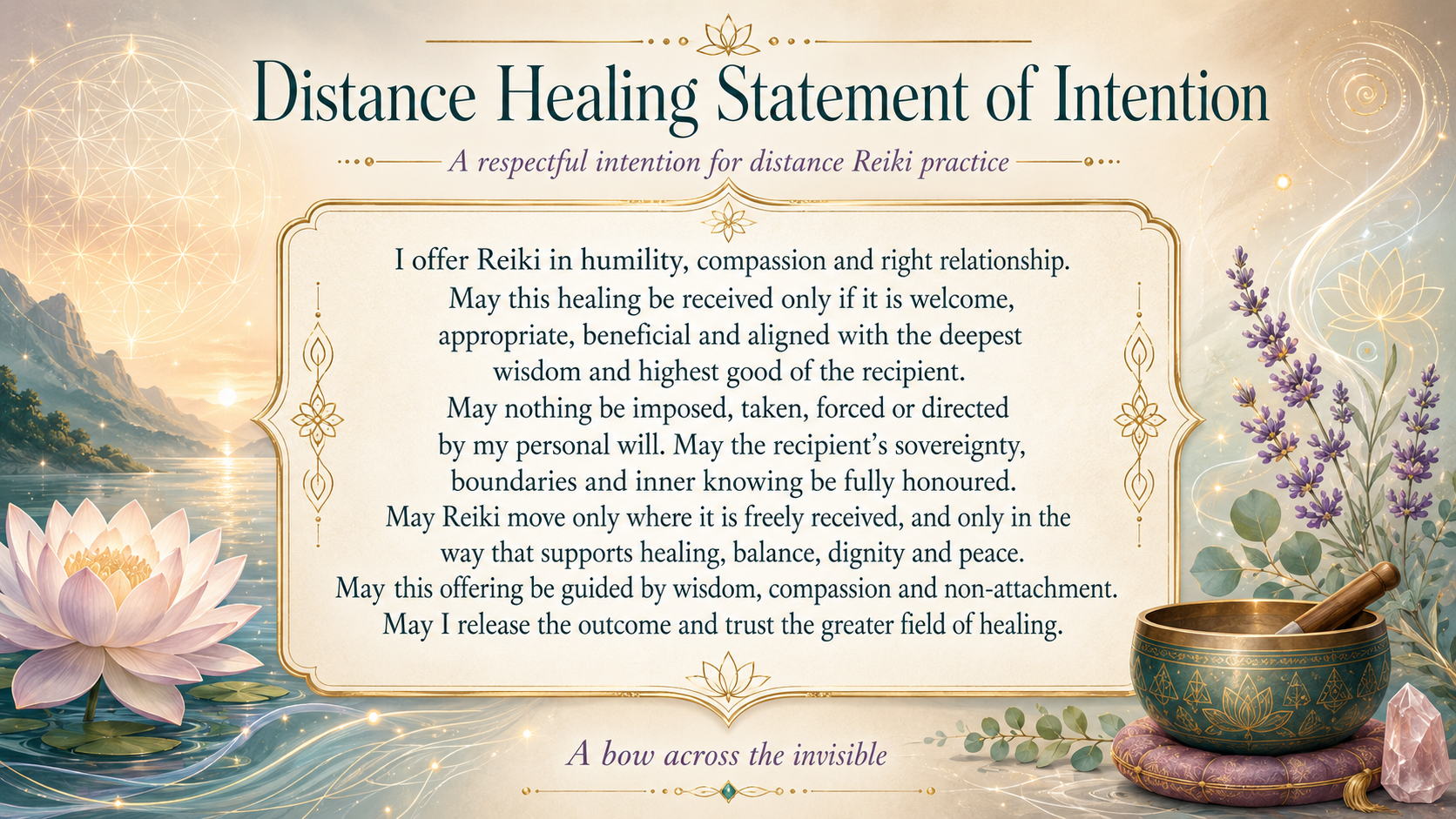
I offer Reiki in humility, compassion and right relationship. May this healing be received only if it is welcome, appropriate, beneficial and aligned with the deepest wisdom and highest good of the recipient. May nothing be imposed, taken, forced or directed by my personal will. May the recipient’s sovereignty, boundaries and inner knowing be fully honoured. May Reiki move only where it is freely received, and only in the way that supports healing, balance, dignity and peace. May this offering be guided by wisdom, compassion and non-attachment. May I release the outcome and trust the greater field of healing.
This kind of intention protects the practitioner from egoic interference and honours the person receiving. It reminds us that distance healing is not about spiritual power over another person. It is about compassionate presence offered with care.
Hon Sha Ze Sho Nen teaches us to recognise the bridge.
But it also teaches us not to misuse it.
The bridge is not a road for intrusion.
It is a path of reverence.
It is a way of remembering that beneath separation, something luminous connects us, and that any contact with that hidden thread must be made gently, respectfully and with an open hand.
Hon Sha Ze Sho Nen is not a spiritual remote control.
It is a bow across the invisible.
Hon Sha Ze Sho Nen as Mantra, Symbol and Sonic Bridge
The phrase Hon Sha Ze Sho Nen contains five primary sound-units:
Hon
Sha
Ze
Sho
Nen
Each syllable has its own phonetic body, energetic gesture and possible symbolic resonance. When spoken or chanted together, they form a movement from grounding into connection, from sound into silence, from individual intention into timeless awareness.
The mantra does not move in a simple upward line. It pulses. It opens, gathers, releases, focuses and seals.
It has a kind of sonic geometry.
Where Sei Hei Ki may be felt as a triadic movement of emotional purification and integration, Hon Sha Ze Sho Nen feels more like a fivefold bridge of consciousness.
It begins in the body.
It reaches through the breath.
It clarifies the field.
It opens the heart-mind.
It seals the connection in timeless presence.
The syllable reflections below are not presented as fixed linguistic facts. They are contemplative sound-healing interpretations: ways of listening into the mantra through voice, breath, resonance and direct experience.
The Five Syllables of Hon Sha Ze Sho Nen
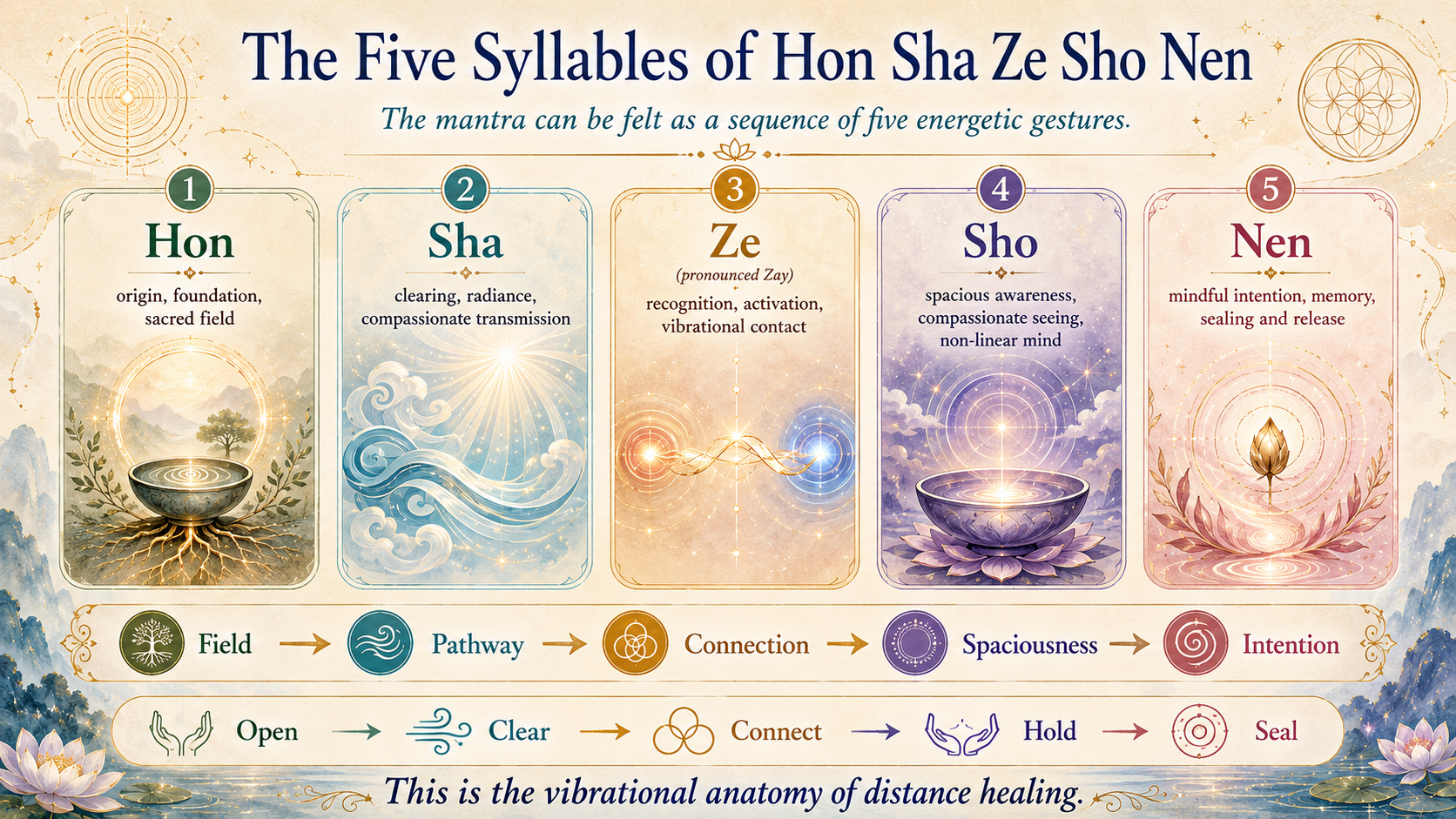
The mantra can be felt as a sequence of five energetic gestures:
Hon: origin, foundation, sacred field
Sha: clearing, radiance, compassionate transmission
Ze: recognition, activation, vibrational contact
Sho: spacious awareness, compassionate seeing, non-linear mind
Nen: mindful intention, memory, sealing and release
Together, the mantra becomes a sonic movement of:
Field → Pathway → Connection → Spaciousness → Intention
Or, in simpler practice language:
Open → Clear → Connect → Hold → Seal
This is the vibrational anatomy of distance healing.
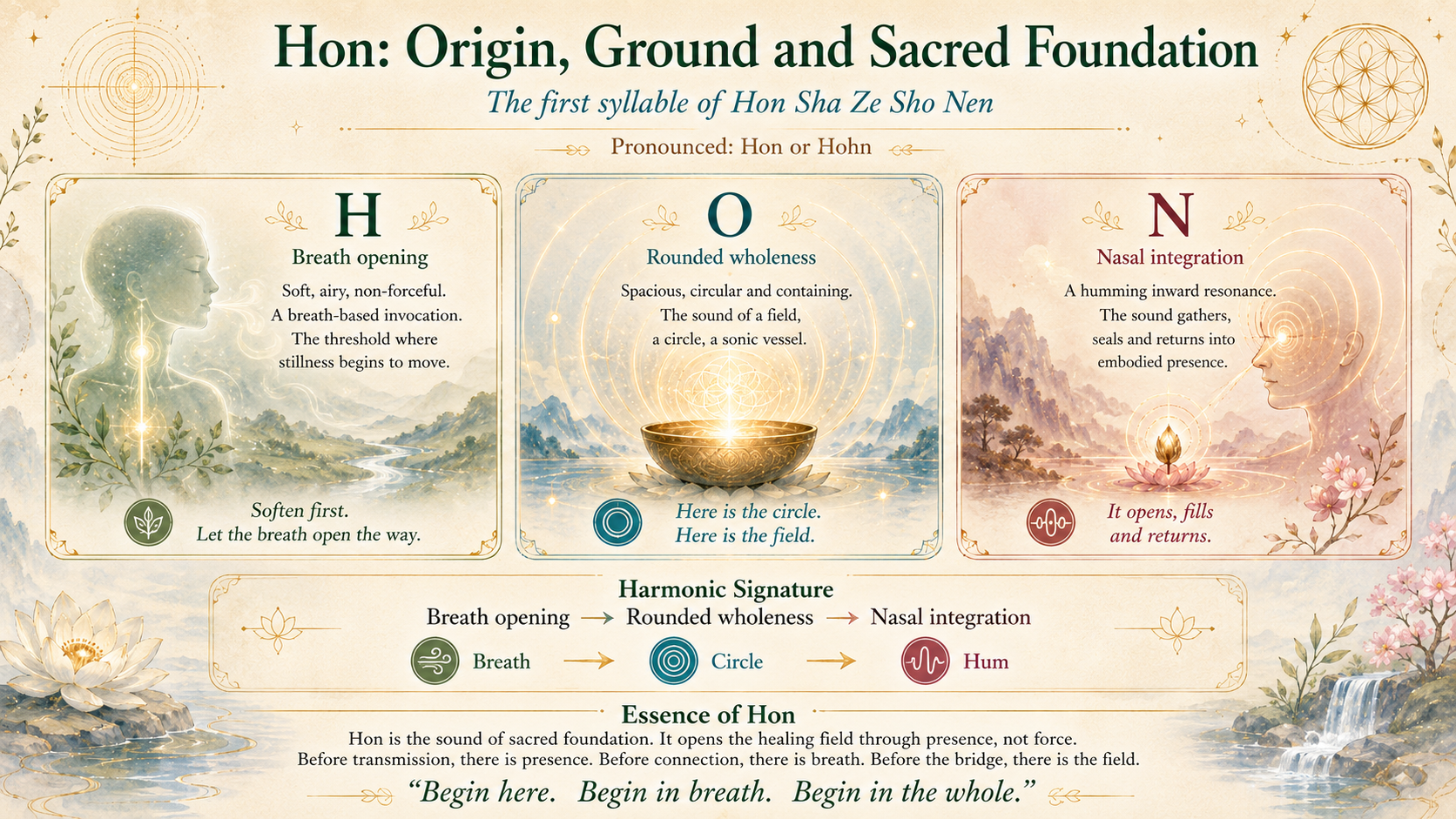
1. Hon: Origin, Ground and Sacred Foundation
Pronounced: Hon or Hohn
Phonetic Composition
H: Voiceless glottal fricative
O: Rounded back vowel
N: Nasal consonant
The syllable Hon begins with breath, opens into a rounded vowel, and closes with nasal resonance. It has a complete arc of movement: emergence, fullness and containment.
It feels like a sound born from the cave of the body.
It begins quietly.
It expands.
It gathers itself back into stillness.
Where later syllables in Hon Sha Ze Sho Nen may feel more directional, connective or spacious, Hon gives the mantra its ground. It establishes the foundation from which the whole distance healing practice can unfold.
Before there is transmission, there is presence.
Before there is connection, there is breath.
Before there is a bridge, there is the field.
The H Sound
The H sound is formed by allowing breath to pass through an open glottis. It is soft, airy and non-forceful. Unlike sharper consonants, it does not strike, cut or push. It simply breathes itself into sound.
Energetically, H may evoke a soft opening of the channel, a breath-based invocation, a gentle activation of the heart and throat, and a movement from silence into sound.
It is the threshold.
The first mist of voice.
The moment stillness begins to move.
In subtle practice, the H sound invites the practitioner to soften. It reminds us that Reiki is not something we manufacture by effort. It is something we allow through presence, humility and attunement.
The practitioner does not become a hammer.
The practitioner becomes a hollow reed.
This is especially important in distance healing. If the practitioner begins with force, the whole practice can become tense and overly mental. But if the practice begins with breath, the field opens more naturally.
The H in Hon says:
Soften first.
Let the breath open the way.
The O Vowel
After the breath of H, the sound opens into O.
The O sound is rounded, spacious and containing. It can resonate through the chest, mouth, skull and heart-field, depending on pitch and vocal placement. When chanted slowly, it may feel circular, womb-like and whole.
It creates a sonic vessel.
It is the sound of a circle.
It is the sound of a field.
It is the sound of presence becoming spacious.
Energetically, O may suggest wholeness, completion, containment, the field of origin, the circle of being, and the heart as a resonant chamber.
In the context of Hon Sha Ze Sho Nen, the O in Hon can be felt as the opening of the healing field itself. It is not yet directed towards a person, memory or future event. It is simply present.
It does not reach yet.
It holds.
It says:
Here is the circle.
Here is the field.
Here is the ground of healing.
The N Sound
The syllable closes with N, a nasal consonant. Nasal sounds often create vibration in the face, sinuses, skull and upper palate. They can produce a humming, internalised resonance that continues even after the audible sound has ended.
This gives Hon a feeling of sealing and inward gathering.
The breath opens.
The vowel expands.
The nasal closure gathers the sound into the subtle body.
Energetically, N may suggest integration, internal resonance, continuity beyond the spoken sound, subtle vibration in the head and brow, and a hum that carries on in silence.
The final N is important because it prevents the syllable from dissolving too quickly. It gives the sound a place to land. It completes the arc of the syllable, drawing the opened field back into embodied awareness.
Hon does not simply open outward.
It opens, fills and returns.
It creates ground.
Harmonic Signature of Hon
Breath opening → rounded heart-field → nasal integration
Hon is the sound of sacred foundation.
It establishes the ground of the practice. It opens the healing space not as a physical location, but as a field of awareness. The sound begins with breath, expands into the rounded fullness of O, then seals into the subtle hum of N.
The harmonic movement of Hon can be felt as:
Breath → circle → hum
Opening → wholeness → integration
Silence → field → embodied presence
This makes Hon the origin point of the mantra. It is the place where the practitioner settles, softens and remembers that healing begins not with effort, but with presence.
Energetic Interpretation
Hon can be understood as the invocation of origin.
It brings the practitioner into contact with the source-field, the place before separation, the ground from which healing arises. In distance healing, this is essential. Before we can move beyond time and space, we must first root ourselves in the present moment.
Hon reminds us that the foundation of distance Reiki is not imagination alone, nor forceful intention, nor the desire to make something happen.
The foundation is presence.
A grounded body.
A softened breath.
A listening heart.
If Hon opens the field, then everything that follows can arise from steadiness rather than strain.
Hon says:
Begin here.
Begin in breath.
Begin in the whole.
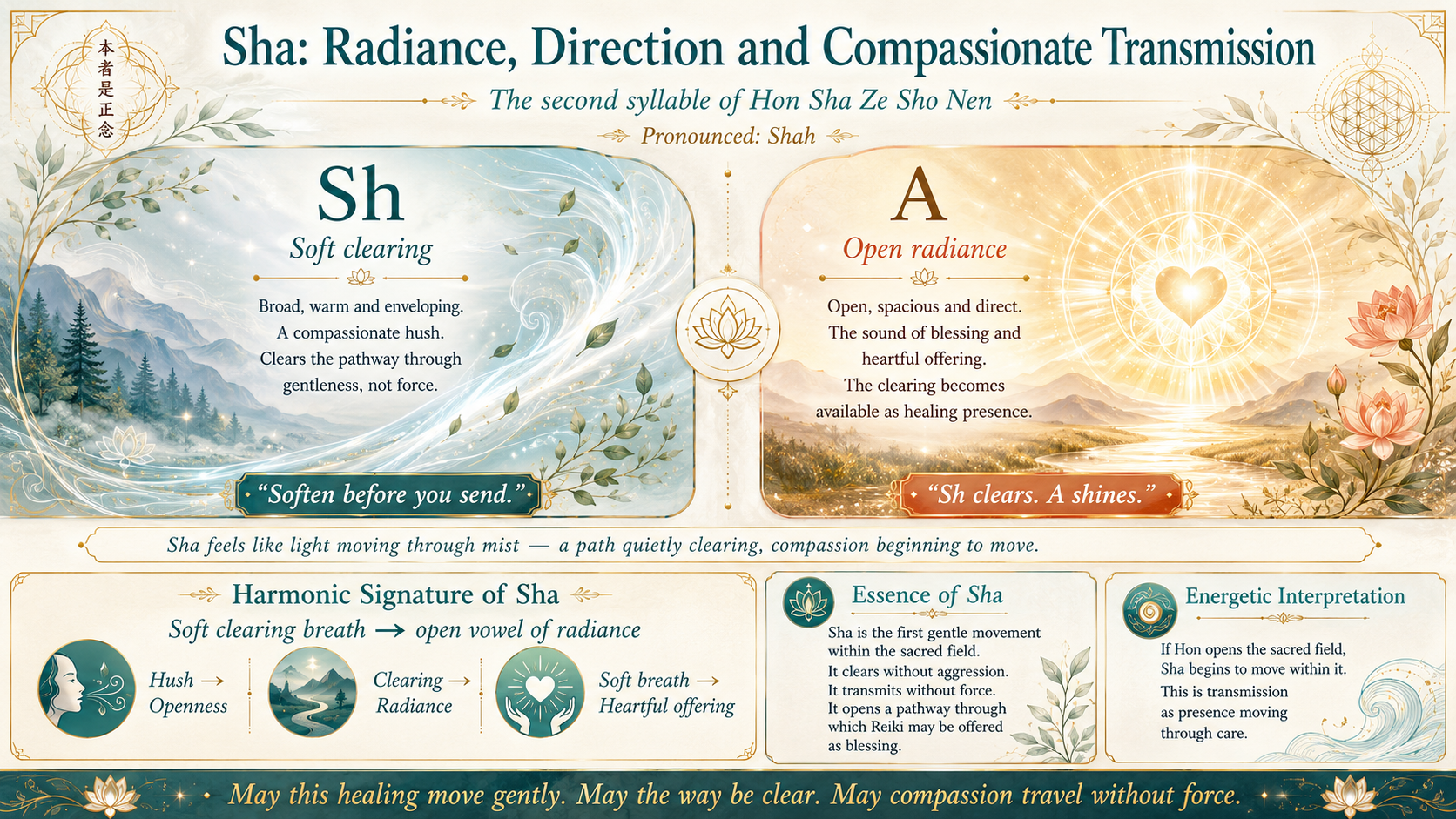
2. Sha: Radiance, Direction and Compassionate Transmission
Pronounced: Shah
Phonetic Composition
Sh: Voiceless postalveolar fricative
A: Open vowel
The syllable Sha has a very different quality from Hon.
Where Hon is rounded, grounded and inwardly resonant, Sha is more radiant, directional and expressive. It begins with the soft rushing breath of Sh, then opens into the wide, primal vowel A.
It feels like light moving through mist.
It feels like a path quietly clearing.
It feels like compassion beginning to move.
If Hon establishes the sacred field, Sha is the first gentle movement within that field. It does not force anything open. It does not push. It simply allows the breath, intention and healing presence to begin travelling with warmth and clarity.
The Sh Sound
The Sh sound is formed by directing air through a narrow channel between the tongue and the roof of the mouth. It creates a soft, textured rushing sound. Unlike S, which can feel sharper and more precise, Sh is broader, warmer and more enveloping.
It has the feeling of a hush.
Not a command to be silent, but an invitation to soften.
Energetically, Sh may evoke subtle clearing, soft purification, the movement of wind through leaves, a veil being parted, a compassionate hush, and the quieting of mental noise.
In many spiritual and healing contexts, sounds like Sh naturally invite stillness. They resemble the instinctive sounds of human care: the gentle shushing of a baby, the calming of distress, the softening of an agitated field.
This matters in Reiki practice because distance healing requires a quiet mind.
The practitioner must listen more than impose.
They must soften before they send.
They must become clear enough for compassion to move without distortion.
The Sh in Sha helps begin this process. It clears the pathway not through force, but through gentleness.
The A Vowel
After the soft clearing of Sh, the sound opens into A.
The A sound is one of the most open vowels. It emerges naturally from the mouth and can resonate through the chest, throat, belly and heart-field, depending on how it is chanted.
It is direct.
It is spacious.
It is unhidden.
Energetically, A may suggest openness, emergence, blessing, direct expression, heartful offering, and the first cry of manifestation.
In many sacred sound systems, open vowels carry a sense of primordial expression. They feel close to the beginning of voice itself: the moment inner feeling becomes sound.
In Sha, the A vowel gives the syllable its radiance. It allows the clearing quality of Sh to become an offering. The sound does not remain private or inward. It opens. It extends. It becomes available.
Sh clears.
A shines.
Together, they create a soft but radiant movement of compassionate transmission.
Harmonic Signature of Sha
Soft clearing breath → open vowel of radiance
Sha is the sound of compassionate direction.
It clears without aggression.
It transmits without force.
It opens a pathway through which Reiki may be offered, not as a command, but as a blessing.
The harmonic movement of Sha can be felt as:
Hush → openness
Clearing → radiance
Soft breath → heartful offering
This is why Sha feels so important after Hon. Once the sacred field has been opened, the healing intention begins to move. But it moves gently. It moves with care. It moves as blessing rather than pressure.
Energetic Interpretation
If Hon opens the sacred field, Sha begins to move within it.
Sha can be felt as the first extension of healing intention. It does not yet define a target rigidly or tighten around an outcome. Rather, it allows the practitioner’s compassion to become spacious, clear and available.
This is the beginning of transmission.
Not transmission as force.
Not transmission as control.
Transmission as presence moving through care.
In distance Reiki, this is essential. The practitioner is not trying to push energy across space. They are allowing healing awareness to become gently directed, like a warm current travelling through an already connected field.
Sha says:
May this healing move gently.
May the way be clear.
May compassion travel without force.
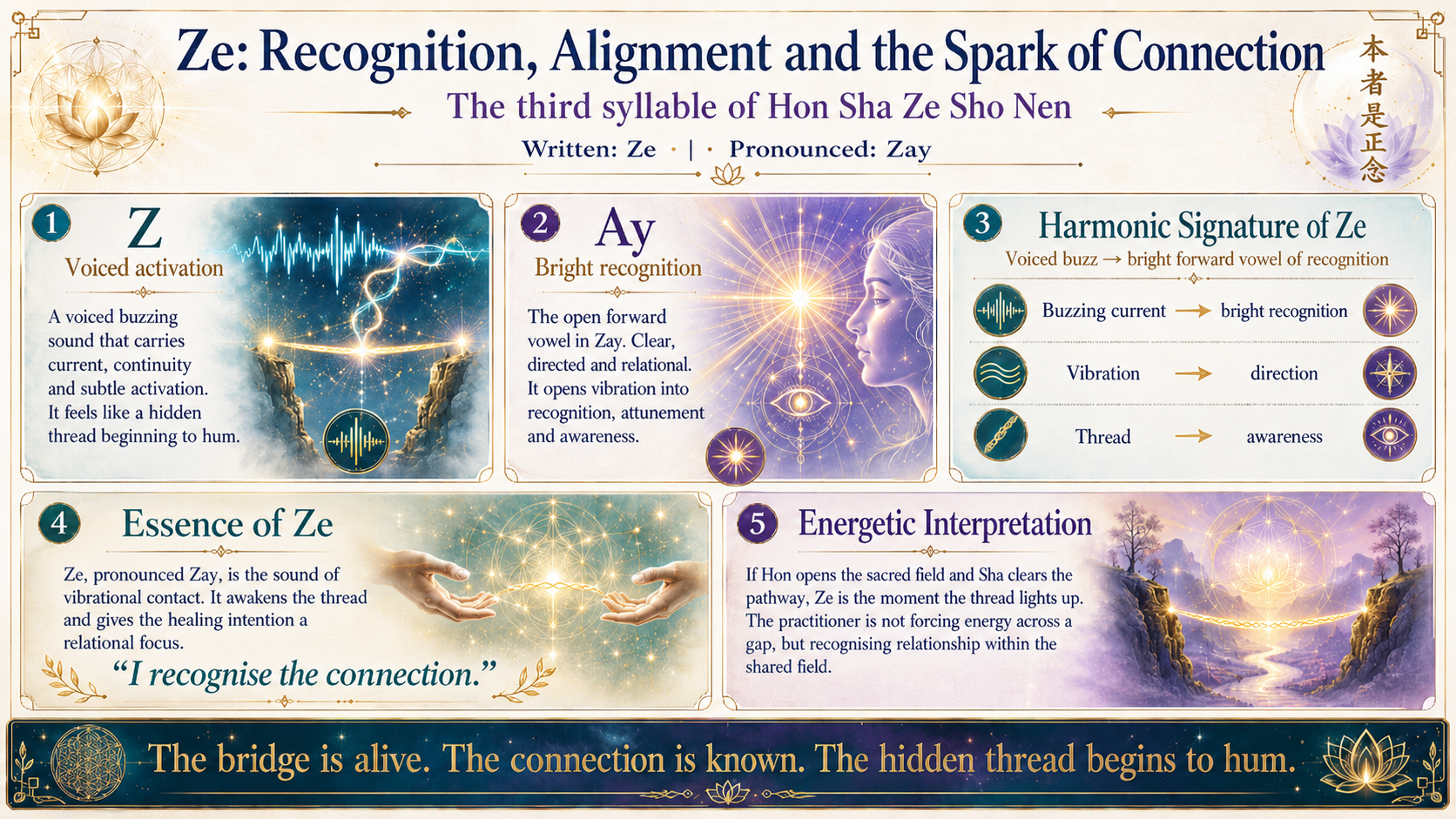
3. Ze: Recognition, Alignment and the Spark of Connection
Written: Ze
Pronounced: Zay
Phonetic Composition
Z: Voiced alveolar fricative
Ay: Open forward vowel sound
The syllable Ze, pronounced Zay, introduces a new quality into the mantra: vibration through voicing.
Unlike the unvoiced Sh of Sha, the Z sound activates the vocal cords. It buzzes. It carries current. It has a living thread of vibration inside it.
This makes Ze, or Zay in spoken practice, feel more electrical, connective and relational than the previous syllables.
It is a thread beginning to hum.
It is the first clear spark of contact.
The Z Sound
The Z sound is made by placing the tongue near the ridge behind the teeth while the vocal cords vibrate. It is similar in mouth position to S, but voiced. This voicing is crucial.
Z carries buzz.
Z carries current.
Z carries continuity.
Energetically, the Z sound may evoke subtle activation, vibrational contact, the awakening of attention, and the meeting point between practitioner and recipient. It can feel like the moment a hidden thread begins to tremble with life.
In sound healing terms, Z can act as a gentle activator. It is not explosive. It does not burst the field open. Instead, it creates a fine, charged vibration that sharpens awareness and brings the sense of connection into focus.
When chanted slowly as part of Zay, the Z may feel like a tiny bridge of sound coming alive between breath, intention and awareness.
The Ay Sound
Although the syllable is written as Ze, in this practice it is pronounced Zay. This changes the harmonic shape of the sound.
Rather than closing quickly into a short “eh” sound, the ay vowel opens and lengthens. It allows the sound to travel further through the mouth, face and field of awareness.
The ay sound has a bright, forward quality. It feels clear, directed and relational. Where O feels rounded and spacious, and A feels open and primal, ay has a more focused brightness. It is like awareness turning towards something and gently recognising it.
Energetically, the ay sound may suggest recognition, perception, attunement, naming, relational clarity and the subtle act of seeing.
This makes Ze, pronounced Zay, a syllable of contact and recognition.
In distance healing, the practitioner may be connecting with a person, a memory, a future event, an ancestral pattern, or a part of the self. Zay carries the sense of identifying the point of connection within the larger field opened by Hon and cleared by Sha.
Harmonic Signature of Ze
Voiced buzz → bright forward vowel of recognition
When Ze is pronounced as Zay, the syllable becomes a movement from vibration into recognition.
The Z begins as a subtle hum of contact. It brings life, current and aliveness into the mantra.
The ay sound then opens that current into clarity, as though the practitioner is not reaching out blindly, but becoming aware of a living presence within the shared field.
So the harmonic movement of Zay can be felt as:
Buzzing current → bright recognition
Vibration → direction
Thread → awareness
Ze, pronounced Zay, is the sound of vibrational contact.
It awakens the thread.
It gives the healing intention a relational focus.
It says, not with force but with clarity:
I recognise the connection.
Energetic Interpretation
If Hon opens the sacred field and Sha clears the pathway, then Ze, pronounced Zay, is the moment the thread lights up.
It may correspond symbolically to the recognition that distance is not absolute. The practitioner becomes aware of the recipient, not as an object “over there”, but as a living presence already held within the wider field of Reiki, compassion and awareness.
This is an important shift.
The practitioner is not trying to force energy across an empty gap.
They are recognising relationship.
They are listening for the hidden thread.
They are allowing the connection to become known.
Zay brings the mantra into contact. It gives the healing field a point of relational clarity without making it rigid or controlling. It helps the practitioner feel that the bridge is not being invented by effort. It is being recognised through awareness.
Ze says:
The bridge is alive.
The connection is known.
The hidden thread begins to hum.
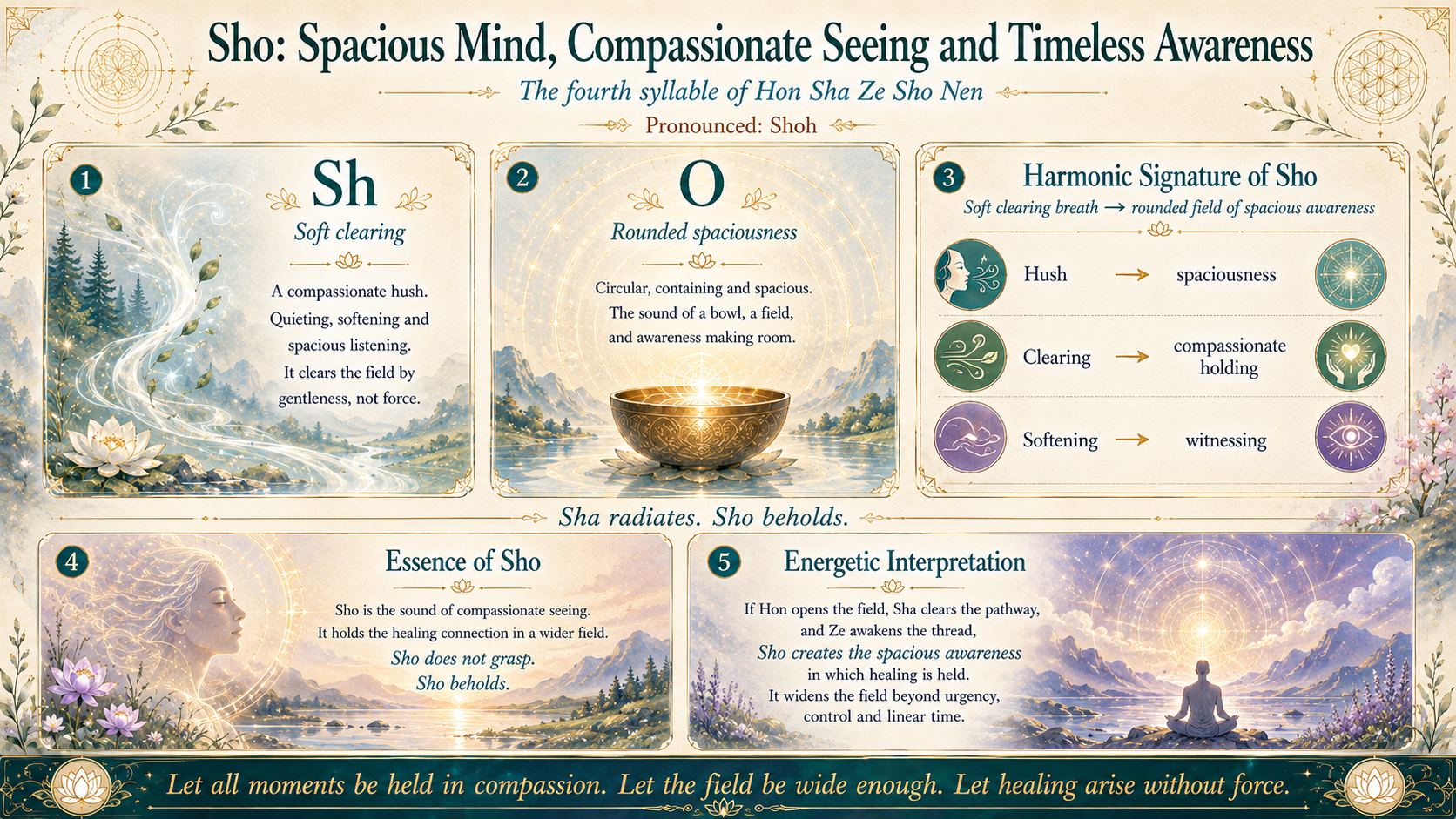
4. Sho: Spacious Mind, Compassionate Seeing and Timeless Awareness
Pronounced: Shoh
Phonetic Composition
Sh: Voiceless postalveolar fricative
O: Rounded back vowel
The syllable Sho combines the soft clearing of Sh with the rounded spaciousness of O. It echoes something of both Sha and Hon, but in a more contemplative and inwardly spacious form.
Where Sha feels like blessing moving outward, Sho feels like awareness opening around everything.
Sha radiates.
Sho beholds.
Sha moves like a warm current of compassionate direction.
Sho opens like a vast bowl of mind, wide enough to hold the person, the memory, the prayer, the wound, the distance and the silence around them all.
The Return of Sh
The repetition of Sh creates a thread of continuity with Sha. Once again, there is a softening, clearing and quieting effect. The sound does not strike the field. It hushes it.
It invites the mind to become quieter.
It invites the breath to become softer.
It invites the practitioner to listen before acting.
The Sh sound can feel like wind moving through leaves, or a gentle veil being drawn aside. It has a subtle cleansing quality, but not an aggressive one. It does not push. It does not cut. It clears by softening.
In Sha, this clearing opens into the bright, primal vowel A. That gives Sha a more radiant, expressive and outward-moving quality.
But in Sho, the Sh opens into O.
This changes the whole energetic direction of the syllable.
The sound no longer moves primarily outward as blessing. It opens into a rounder, wider and more spacious field of awareness.
The O Sound in Sho
The O sound is rounded, spacious and containing. It can resonate through the chest, mouth, skull and heart-field, depending on how it is chanted.
Unlike the open brightness of A, the O sound feels more circular. It creates a sense of enclosure, not as limitation, but as compassionate holding.
It is the sound of a bowl.
It is the sound of a circle.
It is the sound of awareness making room.
Energetically, the O in Sho may suggest spaciousness, containment, non-judgement, the field of compassion, the womb of awareness, and the circle in which all times are held.
When Sh opens into O, the result is not merely clearing. It is clearing into spaciousness.
The syllable Sho does not simply send healing forward. It opens a field in which healing can be held without grasping, forcing or narrowing.
This is why Sho feels so important in the distance healing sequence. When working with another person’s suffering, a past trauma, a future anxiety, an ancestral pattern, or a delicate emotional wound, the practitioner must avoid collapsing into urgency, drama or control.
Sho reminds us to widen.
To witness.
To let the healing field become spacious enough for wisdom to move in its own way.
Harmonic Signature of Sho
Soft clearing breath → rounded field of spacious awareness
Sho is the sound of compassionate seeing.
It allows the healing connection to be held in a wider field. The practitioner is not merely sending energy. They are entering a contemplative state in which the recipient, the intention, the past, the future and the present moment are all held within one luminous bowl of awareness.
Sho does not try to fix.
Sho does not chase.
Sho does not grasp.
Sho beholds.
Energetic Interpretation
If Hon opens the sacred field, Sha clears the pathway, and Ze awakens the thread of connection, then Sho creates the spacious awareness in which that connection can be held with compassion.
Sho may be understood as the opening of timeless mind. It softens the sense of linear time. Past, present and future are no longer rigid compartments. They become movements within the same field.
Waves in the same sea.
Echoes in the same listening chamber.
Sho teaches the practitioner to rest in awareness rather than effort. It reminds us that healing does not always deepen through doing more. Sometimes it deepens when the field becomes wider, quieter and more receptive.
Sho says:
Let all moments be held in compassion.
Let the field be wide enough.
Let healing arise without force.
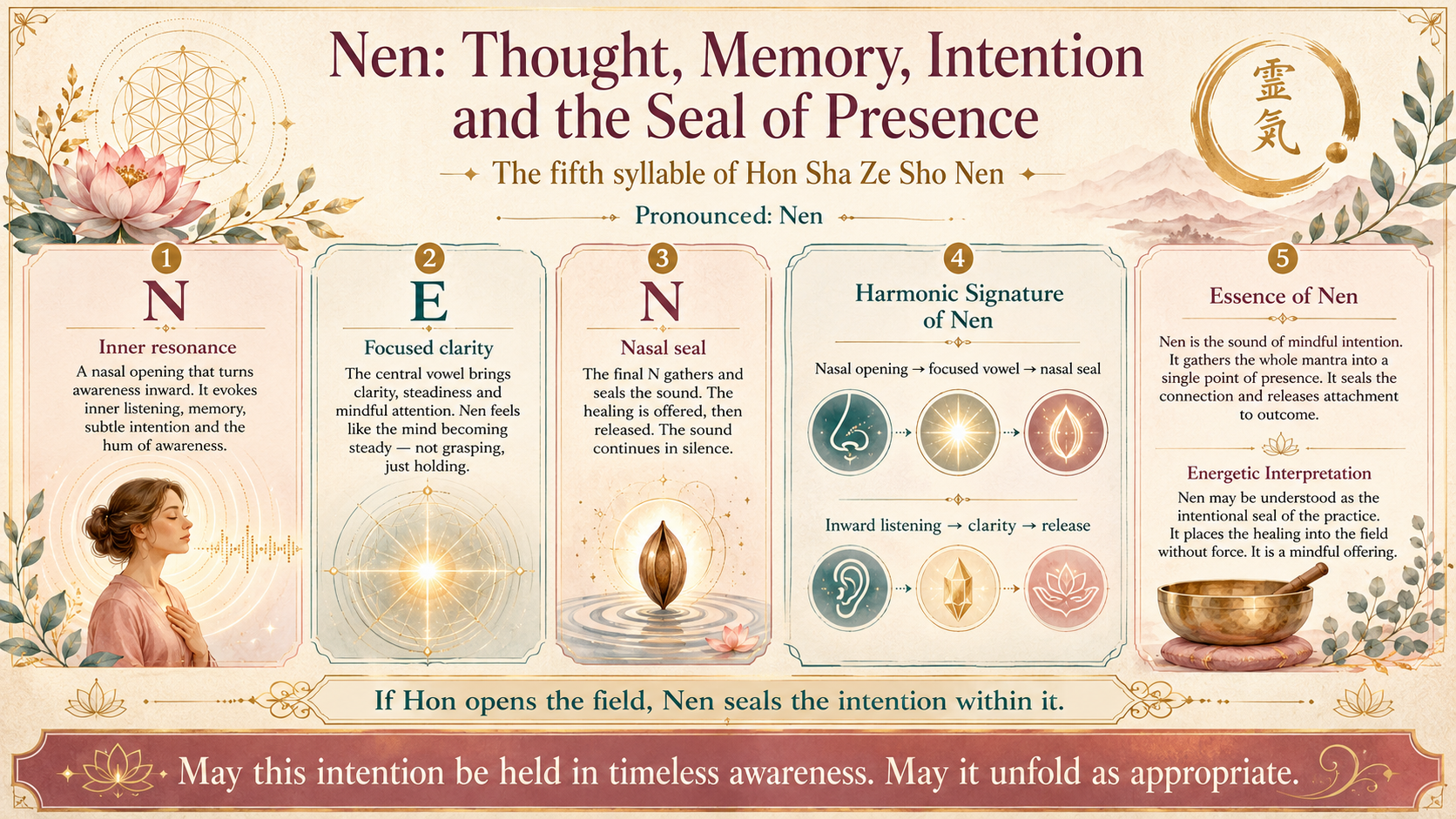
5. Nen: Thought, Memory, Intention and the Seal of Presence
Pronounced: Nen
Phonetic Composition
N: Nasal consonant
E: Mid-front vowel
N: Nasal consonant
The final syllable, Nen, begins and ends with nasal resonance. It is contained, focused and inwardly vibrating. It has the feeling of a seed being placed into fertile ground.
If Hon opens the field, Nen seals the intention within it.
The Initial N
Beginning with N immediately brings the sound into the nasal passages and skull resonance. It has an internal quality. It is not as outwardly expressive as Sha or Ze.
Energetically, the initial N may evoke:
-
Inner listening
-
Memory
-
Thought-form
-
Subtle intention
-
Continuity
-
The hum of awareness
It draws the mantra inward.
The E Vowel
The central E sound brings clarity and focus. It gives the syllable a mental and intentional quality. In Japanese-derived interpretations, “nen” is often associated with thought, mindfulness, attention or memory, a concept linked with mind, remembrance and intention.
Even when we avoid making rigid linguistic claims, this symbolic association is powerful.
Nen feels like the mind becoming steady.
Not thinking wildly.
Not grasping.
Just holding.
The Final N
The closing N seals the phrase. It continues vibrating internally after the audible sound ends. This gives Hon Sha Ze Sho Nen a beautiful completion. It does not end with a hard stop. It dissolves into hum.
This is symbolically perfect for distance healing.
The healing is offered, then released.
The practitioner does not cling.
The sound continues in silence.
Harmonic Signature of Nen
Nasal opening → focused vowel → nasal seal
Nen is the sound of mindful intention.
It gathers the whole mantra into a single point of presence. It seals the connection and releases attachment to outcome.
Energetic Interpretation
Nen may be understood as the intentional seal of the practice.
It places the healing into the field, but without force. It is not a command. It is a mindful offering.
Nen says:
May this intention be held in timeless awareness. May it unfold as appropriate.
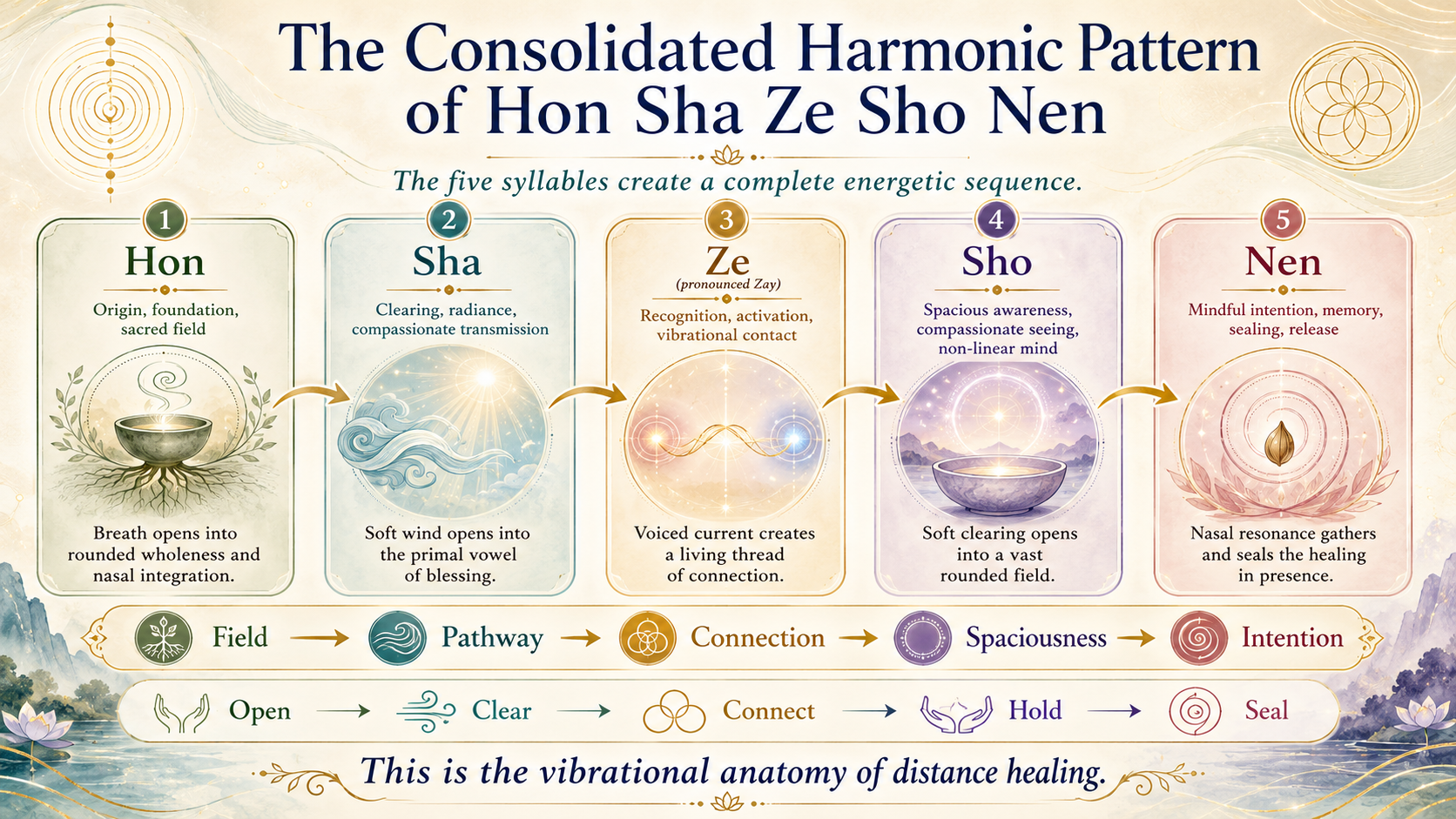
The Consolidated Harmonic Pattern of Hon Sha Ze Sho Nen
The five syllables create a complete energetic sequence.
Hon
Origin, foundation, sacred field
Breath opens into rounded wholeness and nasal integration.
Sha
Clearing, radiance, compassionate transmission
Soft wind opens into the primal vowel of blessing.
Ze
Recognition, activation, vibrational contact
Voiced current creates a living thread of connection.
Sho
Spacious awareness, compassionate seeing, non-linear mind
Soft clearing opens into a vast rounded field.
Nen
Mindful intention, memory, sealing, release
Nasal resonance gathers and seals the healing in presence.
Together, the mantra becomes a sonic movement of:
Field → Pathway → Connection → Spaciousness → Intention
Or, in simpler practice language:
Open → Clear → Connect → Hold → Seal
This is the vibrational anatomy of distance healing.
The Fivefold Sonic Alchemy of Hon Sha Ze Sho Nen
Hon Sha Ze Sho Nen can be felt as a five-stage energetic process.
1. Establish the Field
Hon opens the practitioner into the sacred ground of presence.
2. Clear the Pathway
Sha softens and clears the channel of transmission.
3. Activate the Connection
Ze recognises the living thread between practitioner and recipient.
4. Rest in Spacious Awareness
Sho holds the healing beyond ordinary time and space.
5. Seal with Mindful Intention
Nen completes the practice and releases attachment.
This fivefold process is particularly useful because it prevents distance healing from becoming vague or overly mental. It gives the practitioner a felt sequence.
You do not merely “think about sending Reiki”.
You enter the field.
You breathe.
You clear.
You connect.
You hold.
You release.
Hon Sha Ze Sho Nen and the Illusion of Distance
The most profound teaching of Hon Sha Ze Sho Nen may be that distance is not quite what we think it is. In ordinary life, we tend to experience separation very clearly. You are there, I am here. That event happened in the past. That possibility belongs to the future. This wound belongs to childhood. This fear belongs to tomorrow. Our minds naturally organise experience into places, times, people and stories, and in a practical sense this is useful. Bodies do exist in locations. Events do unfold in time. We still need to remain grounded, sensible and respectful of ordinary reality.
But spiritual practice often reveals a subtler view. The past is not only something behind us. It lives in the body now, as sensation, memory, belief, posture, longing, fear or tenderness. The future is not only something ahead of us. It is being shaped now through imagination, intention, anxiety, hope and choice. Even someone who is physically far away can be held in awareness now. We may not be in the same room, or even the same country, but the heart has its own mysterious geography.
Hon Sha Ze Sho Nen helps the practitioner enter this more spacious, non-linear field. It invites us to work not merely with “distance”, but with relationship: the relationship between past and present, between self and other, between wound and wisdom, between suffering and compassion, between form and emptiness. Healing does not always travel in straight lines. It can spiral, echo, return and ripen. A blessing offered now may soften the way an old memory is held. A compassionate intention may help us approach a future event with more steadiness. A person far away may still be touched through prayer, presence, remembrance and subtle connection.
This does not mean that physical distance is unreal or that we should abandon practical care. Hon Sha Ze Sho Nen is not an excuse to become vague, ungrounded or careless. Rather, it suggests that at the level of healing awareness, connection is more mysterious than geography. The symbol does not deny the map. It simply reminds us that the heart does not always obey it.
In this sense, distance Reiki is not about forcing energy across a gap. It is about entering the field where relationship already exists. Hon Sha Ze Sho Nen becomes a way of remembering the hidden thread: the subtle continuity between then and now, here and there, self and other. We do not create the bridge by effort. We become quiet enough to recognise that, in some deep and luminous way, the bridge was already there.
The Symbolic Function of the Distance Healing Symbol
The written Reiki symbol associated with Hon Sha Ze Sho Nen is visually more complex than some other Reiki symbols. It often appears as an arrangement of strokes, forms and lines that resemble a spiritual script or energetic architecture.
Unlike Cho Ku Rei, which is often experienced as direct, spiralling and powerfully focused, Hon Sha Ze Sho Nen can feel more like a sacred document, a vertical bridge, or a temple made of calligraphic movement.
Symbolically, the shape may be contemplated as:
-
A bridge between dimensions of experience
-
A calligraphic body of the mantra
-
A ladder between ordinary and timeless awareness
-
A seal of spiritual connection
-
A map of non-linear healing
-
A written invocation of compassionate presence
When drawing the symbol, the practitioner may feel that each stroke places part of the bridge into being. The act of drawing becomes meditation. The hand, breath, eye and intention come together.
In this way, the symbol is not merely a sign.
It is a practice.
The Relationship Between Symbol and Sound
The sound Hon Sha Ze Sho Nen and the visual symbol are best understood as two faces of one practice.
The sound moves through the body.
The symbol moves through the hand and eye.
The intention moves through awareness.
Together, they create a triadic activation.
Voice
Chanting or speaking the mantra vibrates the body and breath.
Form
Drawing or visualising the symbol gives structure to the intention.
Mind
Holding the recipient or situation in awareness directs the healing field.
This triad of voice, form and mind is found in many spiritual systems. In Vajrayana terms, one might poetically compare it to the integration of body, speech and mind, though Reiki has its own lineage, language and integrity.
Possible Elemental Correspondences
The mantra can also be contemplated through an elemental lens. These correspondences are symbolic, not fixed.
Hon: Earth and Space
Grounding, origin, sacred foundation, the field that holds all things.
Sha: Air and Fire
Clearing wind, radiant blessing, compassionate direction.
Ze: Fire and Ether
Electrical contact, subtle activation, the spark of recognition.
Sho: Water and Space
Compassionate containment, non-linear awareness, the great bowl of healing.
Nen: Earth and Mind
Intention, memory, sealing, embodied mindfulness.
This creates a movement through the elements:
Space/Earth → Air/Fire → Ether → Water/Space → Earth/Mind
It begins and ends with grounding, but between those two points it opens a bridge through breath, light, vibration and compassion.
That is one of the beauties of Hon Sha Ze Sho Nen. It does not float away into abstraction. Properly practised, it returns us to grounded presence.
Distance healing should not make us vague.
It should make us more deeply present.
Hon Sha Ze Sho Nen as a Bridge Across Time
One of the most fascinating uses of Hon Sha Ze Sho Nen is healing across time.
This is where the distance healing symbol becomes especially subtle. It is not only used to offer Reiki to someone who is physically far away. It may also be used to bring healing awareness to moments that feel distant in time: the past we still carry, the future we are moving towards, and the deeper patterns that seem to echo through memory, ancestry and experience.
Practitioners may use Hon Sha Ze Sho Nen to offer Reiki to:
-
A painful memory
-
A younger version of themselves
-
A traumatic or difficult event
-
An ancestral pattern
-
A future challenge
-
A relationship wound
-
A decision point
-
A moment of transition
-
A collective grief or crisis
This does not mean changing the past in a literal or mechanical way. Reiki is not a time machine. We are not going back to rewrite events as though life were a page we can tear out and replace.
Rather, we may be changing our relationship with the past.
We may be bringing compassion to the way the past still lives in us now.
A memory is not only something that happened “back there”. It may still be present as sensation, posture, fear, belief, longing, shame, protection, tenderness or identity. The body can remember what the mind has tried to file away. The nervous system can continue to respond to echoes of old experience long after the event itself has passed.
The past is not only behind us.
It may be living in the breath.
It may be held in the shoulders.
It may be hidden in the belly.
It may be speaking through the stories we tell about who we are.
When we offer Reiki to the past, we may be offering healing to the way the past is still being carried in the present. Hon Sha Ze Sho Nen becomes a bridge of compassion between the self who suffered then and the self who can offer presence now.
This can be especially tender when working with a younger version of ourselves. The aim is not to force an emotional breakthrough or create a dramatic vision. The aim is to offer support where there may once have been isolation.
A light in the room.
A hand on the heart.
A voice that says, “You are not alone now.”
In this way, Hon Sha Ze Sho Nen may help soften the charge around memory. It may help bring kindness to parts of the self that were frightened, silenced, ashamed or abandoned. It may allow the body to experience a new layer of safety, not by denying what happened, but by meeting what remains with compassion.
The same principle applies to the future.
Sending Reiki to a future event does not mean controlling what will happen. It does not mean trying to bend life to our personal will. It means blessing the path. It means preparing the field. It means entering future moments with more steadiness, clarity and trust.
A medical appointment.
A conversation.
A journey.
A performance.
A birth.
A death transition.
A creative threshold.
A difficult choice.
These moments cannot always be controlled, but they can be met with presence. Hon Sha Ze Sho Nen allows the practitioner to place compassion ahead of them, like a small lamp on the road.
Not to dominate the future.
Not to remove all uncertainty.
But to walk towards it with a clearer heart.
This is the deeper teaching of healing across time. Past and future are not fixed objects outside us. They are also living movements within awareness. The past may appear as memory and body-pattern. The future may appear as imagination, fear, hope and intention. Both can be met through practice.
Hon Sha Ze Sho Nen gives us a way to touch these movements without grasping.
It says:
Do not force the past to change.
Bring compassion to what the past has left behind.
Do not command the future to obey.
Bless the path and walk with steadiness.
We do not use Hon Sha Ze Sho Nen to dominate time.
We use it to meet time with compassion.
Through this symbol and mantra, healing can become less about distance and more about relationship: the relationship between then and now, memory and body, fear and blessing, wound and wisdom, grief and presence.
The bridge across time is not built from force.
It is woven from awareness.
It is crossed through compassion.
Working with the Past Self
A beautiful and tender practice with Hon Sha Ze Sho Nen is to offer Reiki to a younger version of yourself. This may be a child self, an adolescent self, or simply an earlier version of you who was moving through something difficult. You do not need to force a memory to appear, or search through the past as though you are digging for pain. The practice can begin gently, by allowing an image, feeling, age or moment to arise naturally.
The younger self may appear clearly, or only as a feeling. You may sense a younger part of yourself who needs kindness, reassurance or protection. That is enough. The practice does not need to become dramatic in order to be meaningful. Sometimes the most healing contact begins quietly.
When working in this way, it is important to approach the practice with tenderness and permission. Even though you are working with yourself, there is still a kind of inner consent to honour. Younger parts of us may not be ready to receive too much too quickly. Some parts may need time, patience and safety before they soften. So the practice begins not with force, but with care.
You might sit quietly, breathe slowly, and visualise or sense the younger self before you. You may imagine them at a certain age, in a certain place, or simply held within a field of gentle light. Then, with respect, you can draw or visualise Hon Sha Ze Sho Nen and chant the mantra softly.
You might say inwardly:
May the younger self receive only what is safe, appropriate and healing. May love reach the places where love was missing. May wisdom arrive without force. May this part of me be held with tenderness, dignity and protection.
Then chant slowly:
Hon Sha Ze Sho Nen
Let the sound become a bridge. Not a bridge that drags the past into the present, and not a bridge that forces the younger self to change. A bridge of presence. A bridge of warmth. A bridge that says, “You are not alone now.”
As you chant, you may imagine Reiki moving as light, colour, warmth, sound, breath or simple compassionate presence. Some people may sense the younger self receiving comfort. Others may feel very little at first. Both are valid. This is not a performance, and there is no need to create a dramatic experience.
Often the most profound healing is quiet: a softening in the chest, a tear, a breath, a loosening in the belly, or a sense that something long exiled has finally been seen. Sometimes the younger self does not need advice, explanations or reinterpretation. They may simply need presence. They may need protection. They may need the warmth of an older self who can now say, I see you. I am with you. You do not have to carry this alone.
This is one of the deep gifts of Hon Sha Ze Sho Nen. It allows compassion to move across the inner landscape of time. It helps the practitioner bring Reiki not only to an event, but to the way that event still lives in the body, memory and nervous system. The aim is not to erase the past. The aim is to bring love to the places where the past is still waiting to be met.
When the practice feels complete, release the image gently. Do not cling to the younger self or try to keep the experience going. Let them dissolve into light, warmth or spaciousness. Return to your breath. Feel your body. Notice the room around you.
You might close with:
May this healing be received only as deeply as is safe and appropriate. May all parts of me be held in wisdom, compassion and peace. May the past be met gently, and may the present become a place of greater kindness.
Then rest, and let the sound continue in silence.
Working with Future Events
Hon Sha Ze Sho Nen may also be used to bless a future event. This might be a medical appointment, an important conversation, a journey, a performance, a birth, a death transition, a legal matter, a class or healing session, a creative project, or a family gathering.
In this kind of practice, the purpose is not to manipulate the outcome. We are not trying to bend the future to our personal will, or use Reiki as a way of controlling what happens. Rather, we are bringing Reiki, clarity and compassion to the field around the event, so that whatever unfolds may be met with greater steadiness, wisdom and support.
This is an important distinction. Sending Reiki to the future is not the same as demanding a particular result. It is more like placing a small lamp on the path ahead. The lamp does not remove the path. It does not decide what the path must become. It simply offers light, warmth and orientation.
You might begin by sitting quietly and bringing the future event gently into awareness. Try not to imagine every possible problem or outcome. Simply sense the event as a field of experience that has not yet fully arrived. You might see it as a doorway, a room, a landscape, a meeting place, or a moment held in soft light.
Then draw or visualise Hon Sha Ze Sho Nen over the event and chant the mantra slowly:
Hon Sha Ze Sho Nen
As you chant, you may imagine Reiki surrounding the event with steadiness, compassion and protection. You are not forcing a result. You are blessing the conditions. You are asking that the situation be held in the clearest possible field.
You might offer the intention:
May this future event unfold with the greatest possible wisdom, protection, compassion and benefit for all involved. May I meet it with steadiness, clarity and an open heart. May nothing be forced by my fear or grasping. May the path be blessed, and may the outcome serve healing, dignity and right relationship.
Then release it.
The release is essential. Without release, intention can become anxiety wearing ceremonial robes. We may think we are blessing the future, when really we are rehearsing our fear in spiritual language.
So after offering Reiki, let the image soften. Let the symbol dissolve. Let the future return to mystery. Feel your body. Feel your breath. Come back to the room.
This practice can be especially helpful when the future feels charged with uncertainty. It allows you to meet what is coming without collapsing into control. Instead of trying to possess the outcome, you place compassion on the path and return to the present moment.
Hon Sha Ze Sho Nen teaches us that the future does not need to be dominated.
It can be blessed.
It can be prepared for.
It can be met with a steadier heart.
Working with Others at a Distance
When sending Reiki to another person, consent is ideal. If direct consent is not possible, some practitioners offer Reiki to the person’s higher wisdom or deepest good, with the clear condition that the energy only be received if appropriate.
A respectful distance healing intention might be:
I offer Reiki for the highest good of this person, only in the way their being freely receives and benefits from. May nothing be imposed. May all healing be guided by wisdom and compassion.
This keeps the practice clean.
Hon Sha Ze Sho Nen is not a spiritual remote control.
It is a bow across the invisible.
The Nervous System and Chanting
Although the energetic meanings of Reiki symbols are spiritual and experiential, chanting itself can have grounded bodily effects.
Slow vocalisation may support:
-
Longer exhalation
-
Gentle breath regulation
-
Increased bodily awareness
-
Relaxation response
-
Emotional settling
-
Focused attention
-
A sense of ritual safety
-
Internal vibration through the chest, throat, skull and face
When chanting Hon Sha Ze Sho Nen slowly, the repeated breath sounds, rounded vowels and nasal closures may help bring the practitioner into a calmer, more receptive state.
This matters because the practitioner’s state is part of the healing environment.
If the practitioner is tense, forceful, distracted or emotionally entangled, the session may feel muddy. If the practitioner is grounded, compassionate and spacious, the healing field often feels clearer.
In this sense, the mantra does not only “send” healing.
It tunes the healer.
Suggested Chanting Practice
When working with Hon Sha Ze Sho Nen, try chanting the mantra slowly and gently. The aim is not to perform the sound perfectly, but to let the mantra shape the breath, gather the mind, and open the field of awareness.
Allow the sound to be unforced.
Let the breath lead.
Let the body listen.
You may chant aloud, speak softly, or whisper. Each approach has its own quality. A full voice can help the mantra feel embodied and resonant. A softer voice may feel more intimate and internal. A whisper can make the practice especially subtle, as though the mantra is being carried on the edge of breath.
Before beginning, sit comfortably. Let the spine be upright but not rigid. Take a few natural breaths and allow the body to settle. If you work with Reiki in a particular lineage, you may invite Reiki in the way you have been taught. Then allow the mantra to arise slowly.
Version 1: One Syllable Per Exhale
This version gives each syllable its own breath. It is useful when you want to feel the energetic gesture of each sound clearly.
Inhale gently.
Exhale:
Hon
Inhale gently.
Exhale:
Sha
Inhale gently.
Exhale:
Ze
Inhale gently.
Exhale:
Sho
Inhale gently.
Exhale:
Nen
After the final syllable, pause. Let the body be still for a moment. Notice where the sound lingers. You may feel vibration in the chest, throat, mouth, face, skull, hands, or heart-field. You may also simply feel quieter.
There is no need to search for an experience.
Just listen.
This version can be especially helpful when contemplating the fivefold movement of the mantra:
Open → Clear → Connect → Hold → Seal
Version 2: One Full Mantra Per Exhale
In this version, the whole mantra is chanted as one flowing phrase.
Inhale gently.
Exhale slowly:
Hon Sha Ze Sho Nen
Let the phrase move like one river of sound. Try not to rush. Allow each syllable to remain clear while still belonging to the whole movement of the mantra.
You might feel Hon open the field, Sha clear the pathway, Ze awaken the thread, Sho widen the awareness, and Nen seal the intention in presence.
At the end of the exhale, rest in silence.
Let the sound dissolve.
Let the mantra continue without needing to be spoken.
This version is simple, steady and beautiful for distance healing practice, especially when you are holding a person, memory, future event or situation in compassionate awareness.
Version 3: Whispered Distance Healing
For a more subtle practice, whisper the mantra rather than chanting it aloud.
A whispered Hon Sha Ze Sho Nen places emphasis on breath, intention and intimacy. It can feel less like singing and more like a prayer travelling through the quiet. The sound becomes fine, delicate and inward, as though it is being offered directly into the hidden thread of connection.
This can be especially powerful when working with grief, ancestral healing, a younger self, or delicate emotional material. The whisper keeps the practice gentle. It prevents the energy from becoming too forceful or performative.
You might whisper the mantra three times, nine times, or for as long as feels appropriate.
Then stop.
Let the silence receive the sound.
In all three versions, the most important instruction is simple:
Do not force.
Do not strain.
Do not chase an experience.
Let the mantra become breath, bridge and offering.
Let the sound open the field, then allow the healing to move in its own way.
A Meditative Distance Healing Practice with Hon Sha Ze Sho Nen
This is a simple practice structure you can adapt according to your Reiki lineage, personal rhythm and the situation you are working with. It can be used for another person, a past self, a future event, an ancestral pattern, or a wider situation that you wish to hold in compassion.
The purpose is not to force healing to happen. The purpose is to enter a clear, respectful and receptive state, then offer Reiki through Hon Sha Ze Sho Nen with humility, consent and non-attachment.
Let the practice be simple.
Let it be spacious.
Let it be guided by care.
1. Prepare the Space
Begin by sitting comfortably. Let your spine be upright but not rigid, as though the body is awake without becoming tense. Place your hands on your heart, in your lap, or in gassho, with the palms gently touching at the centre of the chest.
Take several slow breaths. Allow the exhale to lengthen naturally. Let the shoulders soften. Let the jaw loosen. Let the belly have room to breathe.
You may wish to light a candle, dim the room, play soft ambient sound, or simply sit in silence. The outer space does not need to be elaborate. What matters most is the quality of attention you bring.
Let the room become quiet around you.
Let the body become quiet within you.
Arrive before you begin.
2. Invite Reiki
Silently or aloud, invite Reiki in whatever way is natural to your lineage and practice. This may be a formal invocation you have been taught, a simple prayer, or a quiet inward opening to the flow of Reiki.
You might say:
May Reiki flow for the highest good. May this practice be guided by compassion, wisdom and respect. May I become a clear and humble channel for healing, without force, pride or attachment to outcome.
Pause after the invitation. Feel the body. Notice the hands, the breath, the heart-field, and the space around you.
You are not trying to manufacture energy.
You are allowing yourself to become available.
3. Establish Consent and Intention
Before using Hon Sha Ze Sho Nen, become clear about who or what the practice is for.
If you are working with another person, recall their consent. If they have asked for distance Reiki, bring them to mind gently, without trying to hold them too tightly. If direct consent is not available, hold the clear condition that Reiki may only be received if it is welcome, appropriate, beneficial and aligned with their deepest wisdom and highest good.
If you are working with a situation, hold it lightly. Do not wrap it in worry. Simply acknowledge it.
If you are working with a past self, approach tenderly. Let that younger or earlier part of you be met with patience, not pressure.
You might use the intention:
I offer Reiki in humility, compassion and right relationship. May this healing be received only if it is welcome, appropriate, beneficial and aligned with the deepest wisdom and highest good. May nothing be imposed, forced or directed by my personal will. May Reiki move only where it is freely received, and only in the way that supports healing, balance, dignity and peace.
Set the intention clearly.
Then loosen your grip.
4. Draw or Visualise the Symbol
Draw Hon Sha Ze Sho Nen in the air, on your palms, over a photograph, over a written name, over the imagined future event, or in your mind’s eye.
Move slowly.
Let each gesture become part of the meditation.
If you know the symbol formally from your Reiki training, draw it in the way you have been taught. If you are working more contemplatively with the sound and idea of the symbol, you may simply visualise a bridge of light, a thread of connection, or the five syllables opening one by one in awareness.
Let the symbol become a doorway.
Let the hand, eye, breath and intention come together.
Do not rush this part. Drawing the symbol is not just preparation for the practice. It is already part of the practice.
5. Chant the Mantra
Now chant the mantra slowly:
Hon Sha Ze Sho Nen
You may repeat it three times, nine times, or for as long as feels appropriate. You may chant aloud, speak softly, or whisper.
Let each syllable carry its own quality.
Hon opens the field.
Sha clears the pathway.
Ze, pronounced Zay, awakens the thread of connection.
Sho widens the field of compassionate awareness.
Nen seals the intention in presence.
Allow the sound to become a bridge. Let it move through the breath and body rather than only through the mind.
There is no need to perform the mantra beautifully.
The beauty is in the sincerity.
6. Offer Reiki
Place your hands in whatever position feels right. You may hold them over your heart, extend them slightly forward, place them over a written name, rest them in your lap, or place them near the body if working with yourself.
Let Reiki flow.
Do not push.
Do not strain.
Do not try to make something happen.
Allow the energy to move like water finding its own path. It may feel warm, cool, spacious, tingling, quiet, emotional or very subtle. It may not feel dramatic at all. That is fine. The practice does not need spectacle.
If the mind becomes busy, return gently to the mantra:
Hon Sha Ze Sho Nen
Or return to the simple feeling of the hands, the breath and the heart.
7. Rest in Spacious Awareness
After chanting and offering Reiki, sit quietly.
Imagine the person, memory, future event or situation held in a gentle field of light. Do not grip the image. Let it be held softly, as though resting inside a wide bowl of compassionate awareness.
Let past, present and future soften.
Let the need to control soften.
Let the healing field become wider than your personal idea of what should happen.
There is only presence.
There is only listening.
There is only compassion making room.
This is where the practice deepens. Sometimes the most important part of distance Reiki is not the sending, but the resting. In this stillness, the practitioner stops interfering and allows Reiki to move according to its own wisdom.
8. Release the Outcome
When the practice feels complete, release the image gently. Let the symbol dissolve. Let the person, memory, event or situation return to the wider field.
You might say:
May this healing be received only as appropriate. May nothing be forced. May all benefit be dedicated to the wellbeing, dignity and peace of all beings. I release the outcome and trust the greater field of healing.
Then return fully to your body. Feel your feet, hands, breath and surroundings. Notice the contact of the body with the chair or floor. Look around the room. Let ordinary awareness return.
You may wish to drink some water, write a few notes, or rest quietly for a few minutes.
The practice is complete.
The offering has been made.
The bridge can now become silent.
Explore Reiki, Sound Healing and Distance Practice with The Mind Orchestra
If this exploration speaks to you, you may enjoy going deeper through guided practice, sound healing, mantra, meditation and Reiki-inspired work with The Mind Orchestra.
My work weaves together sound healing, voice, mantra, Druidic listening, subtle energy practice, guided meditation and contemplative ritual. Rather than treating healing as something abstract or distant, these practices invite you to experience sound, breath and awareness directly in your own body.
You may wish to add links here to your relevant services and landing pages.
THE MIND ORCHESTRA SERVICES
If you would like to explore sound, mantra and energy healing in a grounded, creative and compassionate way, you are warmly invited to continue the journey through The Mind Orchestra’s sessions, courses and community practice space.
1. Book a 1:1 Sound Healing or Reiki-Inspired Session
3. Explore the Sound Healing Library
Hon Sha Ze Sho Nen and Ancestral Healing
Hon Sha Ze Sho Nen can be especially meaningful in ancestral work because ancestral patterns do not belong neatly to one time period. They move through generations as stories, habits, wounds, gifts, silences, songs, fears, strengths and unfinished grief. What one generation could not speak may become tension in the next. What one ancestor survived may become both burden and medicine in those who follow.
Ancestral healing is therefore not simply about looking backwards. It is about recognising how the past continues to live in the present: in the body, in the family field, in inherited beliefs, in repeated patterns, in unspoken loyalties, and in the quiet ways we carry what was never fully witnessed.
Hon Sha Ze Sho Nen offers a gentle way to bring Reiki into this wider field of time and relationship. The Distance Healing Symbol may be used not to “fix” the ancestors, control the past, or force resolution, but to offer compassion into the lineage field. It becomes a bridge of respect between the living and the dead, between what has been carried and what may now be ready to soften.
This kind of work should be approached slowly.
Not dramatically.
Not heroically.
Not as an attempt to descend into every wound in the family line.
Ancestral work is not about intensity for its own sake. It is about respectful tending. Sometimes the most powerful healing is not a great thunderclap of revelation, but a small candle placed carefully in the old forest.
You might begin by sitting quietly and grounding yourself in the present. Feel your body, your breath, your hands, your feet, and the room around you. Remember that you are here now. You are not trying to become lost in the past. You are offering Reiki from the stability of the present moment.
Then, if it feels appropriate, you might gently visualise your ancestral line behind you. This does not need to be detailed or literal. You do not need to see faces, names or specific stories. You might simply sense a river of lives flowing behind you: countless people, known and unknown, whose choices, struggles, loves, losses and survivals have somehow contributed to your being here.
You may imagine this river stretching back through parents, grandparents, great-grandparents and beyond. Some parts of the river may feel bright. Some may feel heavy. Some may feel hidden. You do not need to investigate everything. You do not need to understand it all.
Simply acknowledge the river.
Then draw or visualise Hon Sha Ze Sho Nen, and chant slowly:
Hon Sha Ze Sho Nen
Let the sound become a bridge through the lineage field. Let it move not as command, but as blessing. Offer Reiki backwards through the line only where it is welcome, appropriate and beneficial. Allow the wisdom of Reiki to decide where the healing may move, rather than trying to direct it through personal will.
You might say:
May the burdens that are ready to soften be softened. May the wisdom that is ready to return be returned. May the gifts of this lineage be honoured, and may the wounds be held with compassion. May the living and the dead be met in dignity, peace and right relationship. May nothing be forced. May healing move only where it is welcome and beneficial.
This intention keeps the practice clean. It reminds us that ancestral healing is not about blaming the past, romanticising the past, or becoming entangled in stories we cannot fully know. It is about bringing compassion to the field of inheritance.
Some ancestral patterns may be painful: silence, fear, poverty, exile, grief, addiction, violence, shame, displacement, emotional absence or spiritual disconnection. Other ancestral streams may carry strength: devotion, craft, resilience, humour, song, prayer, land-knowledge, protection, courage and love. A lineage is rarely one thing. It is a forest of many roots.
Hon Sha Ze Sho Nen can help us hold this complexity with care. It allows us to offer Reiki not only to what was wounded, but also to what was wise. Not only to what was lost, but also to what endured. Not only to the grief, but to the hidden blessing that may still be waiting beneath it.
If strong emotions arise during this work, pause. Open your eyes. Feel your feet. Touch the floor. Drink water. Return to the room. There is no need to push through. If ancestral material feels overwhelming, it may be wise to seek support from a trusted practitioner, therapist, teacher or grounded companion.
The aim is not to carry more.
The aim is to carry differently.
The aim is not to become the healer of the entire family line.
The aim is to place compassion where you can, and let Reiki do only what is appropriate.
When the practice feels complete, release the image of the ancestral line. Let the river flow back into mystery. Feel your own body again, here in this moment. Notice your breath. Notice your hands. Notice that you belong to the present.
You might close with:
May all that has been offered be received only as appropriate. May the ancestors be honoured without being clung to. May the burdens that are not mine to carry return to wisdom. May the gifts that are mine to embody come forward with grace. May this lineage, in all directions of time, be held in compassion.
Then rest.
A small candle in the old forest may be enough.
A single breath of kindness may reach further than we know.
Hon Sha Ze Sho Nen and Self-Healing Across Time
One of the most powerful uses of Hon Sha Ze Sho Nen is self-healing across the landscape of your own life.
We do not only live in the present as one single, tidy self. We carry many layers of ourselves within us: the child who needed safety, the adolescent who needed belonging, the grieving self, the ashamed self, the courageous self, the confused self, the self who made a difficult choice with the understanding they had at the time.
These parts are not failures of wholeness. They are part of the human story. They are rooms within the house of being.
Through Hon Sha Ze Sho Nen, Reiki can be offered across these inner distances. Not to erase the past, and not to judge who we were, but to bring compassion to the way different chapters of life may still be held in the body, memory and heart.
You might offer Reiki to:
-
The child self
-
The adolescent self
-
The self who made a difficult choice
-
The self who was grieving
-
The self who felt abandoned
-
The self who did not know how to speak
-
The self who carried shame
-
The self who needed protection
-
The future self who needs courage
This practice can gradually transform the way your life story is held. Instead of the past being a locked room, it becomes a room you can enter with a lamp. You do not go in to disturb what is not ready. You do not go in to force forgiveness, understanding or release. You enter with warmth, patience and respect.
Hon Sha Ze Sho Nen becomes that lamp.
It allows you to meet yourself across time with less judgement and more tenderness. The younger self does not need to be corrected. The grieving self does not need to be rushed. The ashamed self does not need another voice of criticism. The frightened self does not need to be told to be stronger.
Each part may simply need to be met.
Seen.
Held.
Allowed to breathe.
This is where self-healing becomes a practice of relationship. You are not trying to become a perfect, purified version of yourself with no history. You are learning how to be in wiser relationship with the many selves you have been. Reiki becomes a way of bringing kindness into the places where the inner story has become tight, painful or unfinished.
You may also use Hon Sha Ze Sho Nen to connect with a future self. Not as a way of controlling who you become, but as a way of offering courage and blessing to the part of you walking towards what has not yet arrived. This may be the self preparing for change, healing, creativity, grief, love, leadership, uncertainty or transformation.
In this way, Hon Sha Ze Sho Nen can move both backwards and forwards through the inner field of life.
It can comfort what was wounded.
It can steady what is becoming.
It can soften the old story without denying it.
It can bless the new path without trying to control it.
Self-healing across time is not about escaping the present. It is about returning to the present with more of yourself gathered in compassion. The past does not need to remain a locked room. The future does not need to remain a corridor of fear.
There can be a lamp.
There can be breath.
There can be Reiki.
And through Hon Sha Ze Sho Nen, there can be a quiet bridge of healing between the selves we have been, the self we are now, and the self still becoming.
A Poetic Syllable Meditation
You may wish to meditate on the syllables in this way:
Hon
I enter the field of origin.
Sha
I clear the path with compassion.
Ze
I recognise the living thread.
Sho
I rest in spacious awareness.
Nen
I seal the healing in mindful presence.
Or more poetically:
Hon
The circle opens.
Sha
The wind clears the veil.
Ze
The hidden thread begins to hum.
Sho
The sky holds all moments.
Nen
The seed of intention rests in silence.
The Distance Healing Symbol as a Teaching on Non-Separation
At its deepest level, Hon Sha Ze Sho Nen is a teaching on the nature of separation itself.
In ordinary consciousness, we tend to divide reality into fragments. Here and there. Then and now. Me and you. Before and after. Wound and healing. This is how the thinking mind organises experience, and in practical life these distinctions matter. We do live in bodies. We do move through time. We do have different histories, needs, boundaries and responsibilities.
But spiritual practice repeatedly invites us into a more subtle perception. Difference exists, yet beneath difference there is relationship. Forms arise separately, yet they are woven into a shared field. A person may be far away, yet still present in the heart. A memory may belong to the past, yet still live in the body. A future possibility may not have arrived, yet it may already be shaping the breath, the imagination and the nervous system.
Hon Sha Ze Sho Nen helps us practise from this woven awareness. It does not deny ordinary reality, and it does not erase individuality. Instead, it reminds us that individuality and connection are not opposites. We can honour each being as distinct, sovereign and complete, while also recognising that life is threaded through relationship.
The Distance Healing Symbol does not make everything the same.
It reveals that everything is in relationship.
It does not dissolve the person.
It sanctifies the connection.
This is why humility matters so deeply. If all beings are connected, then healing work must be done with reverence. We are not superior beings sending light to lesser beings. We are not rescuers standing above the world. We are participants in a living web, offering care through the threads available to us.
That care must be gentle. It must be ethical. It must respect consent, sovereignty and the mystery of the other person’s path. Connection is not ownership. Spiritual sensitivity is not permission to interfere. The more deeply we recognise interconnection, the more carefully we must move.
Hon Sha Ze Sho Nen asks us to become quiet enough to feel the bridge without claiming it.
The thread is not ours.
The field is not ours.
The outcome is not ours.
We are allowed to touch the thread only with respect.
In this way, distance Reiki becomes a practice of right relationship. We offer without forcing. We bless without grasping. We recognise connection without collapsing boundaries. We allow healing to move according to wisdom, not personal will.
Hon Sha Ze Sho Nen reminds us that beneath the apparent distance between self and other, past and present, wound and healing, something luminous remains connected.
Not possessed.
Not controlled.
Simply connected.
And when we touch that connection with humility, Reiki becomes less like an act of sending and more like an act of remembering.
Common Mistakes in Distance Reiki Practice
1. Trying Too Hard
Distance healing often works best when the practitioner relaxes. Excessive effort can create tension. Reiki is allowed, not forced.
2. Becoming Attached to Results
It is natural to hope someone feels better. But attachment can narrow the field. Offer the healing, then release.
3. Ignoring Consent
Energetic work should be respectful. When in doubt, offer Reiki only to the person’s highest good and only if it is freely received.
4. Treating Reiki as a Replacement for Practical Care
Reiki can be deeply supportive, but it should not replace medical, psychological, legal or practical action when those are needed.
5. Overcomplicating the Practice
The symbol is profound, but the practice can remain simple.
Breathe.
Draw.
Chant.
Offer.
Rest.
Release.
Journaling Prompts for Hon Sha Ze Sho Nen Practice
After working with the symbol, you may wish to reflect on these questions:
-
What did I notice in my body while chanting Hon Sha Ze Sho Nen?
-
Which syllable felt strongest, softest or most mysterious?
-
Did the symbol feel like a bridge, a key, a doorway, a script, or something else?
-
What changed in my perception of distance?
-
Did I feel any resistance to releasing the outcome?
-
What does consent mean in my healing practice?
-
How does my body experience the difference between effort and allowing?
-
What past moment in my life may be ready to receive compassion?
-
What future moment would benefit from blessing rather than control?
-
What does timeless healing mean to me through direct experience?
You might also ask:
Where in my life am I still living as though love cannot reach backwards?
Where am I trying to control the future instead of blessing the path?
What hidden thread is already singing beneath the surface of this situation?
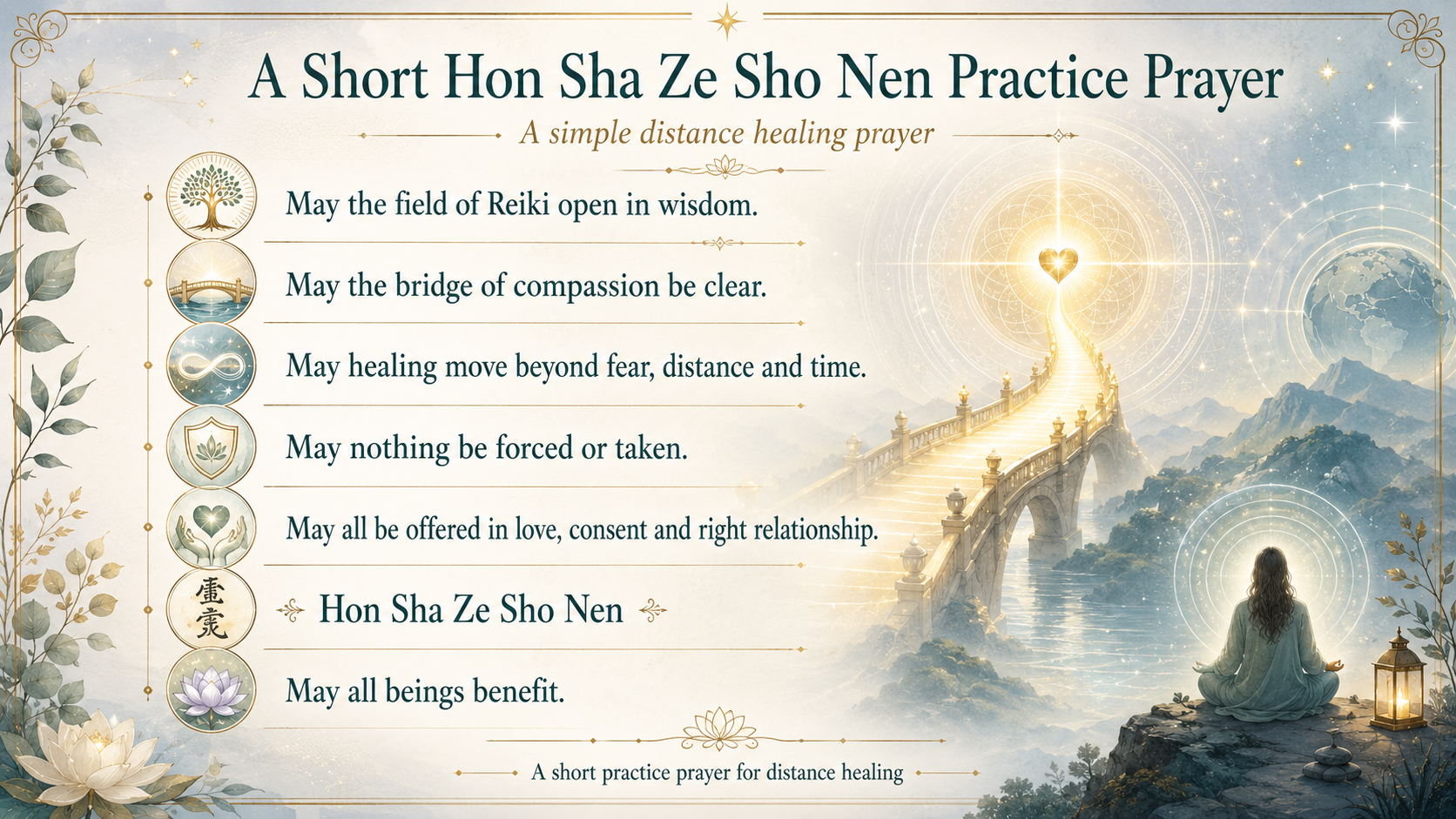
A Short Hon Sha Ze Sho Nen Practice Prayer
You may use or adapt this prayer:
May the field of Reiki open in wisdom.
May the bridge of compassion be clear.
May healing move beyond the limits of fear, distance and time.
May nothing be forced.
May nothing be taken.
May all be offered only in love, consent and right relationship.
Hon Sha Ze Sho Nen.
May all beings benefit.
Frequently Asked Questions About Hon Sha Ze Sho Nen
What is Hon Sha Ze Sho Nen used for?
Hon Sha Ze Sho Nen is commonly used in Reiki practice for distance healing. This may include sending Reiki to someone who is not physically present, offering healing to past memories, blessing future events, and working with emotional, ancestral or spiritual patterns.
It is often taught as a way of working beyond ordinary limits of time and space, while remaining grounded in compassion, consent and respect.
What does Hon Sha Ze Sho Nen mean?
Hon Sha Ze Sho Nen is often interpreted in Reiki teaching as “no past, no present, no future”. It is also sometimes explained as “the divinity in me greets the divinity in you” or “the Buddha in me reaches out to the Buddha in you”.
These interpretations are best understood as symbolic teaching phrases rather than always literal linguistic translations. They point towards the deeper function of the symbol: connection, timelessness and non-separation.
Is Hon Sha Ze Sho Nen the Reiki distance healing symbol?
Yes. In many Reiki lineages, Hon Sha Ze Sho Nen is known as the Reiki distance healing symbol. It is generally taught at Reiki Level 2, where students begin working more consciously with symbols, mantra, intention and distance healing practice.
Do I need Reiki Level 2 to use Hon Sha Ze Sho Nen?
In many Reiki traditions, Hon Sha Ze Sho Nen is formally taught at Reiki Level 2. If you are not attuned to Reiki Level 2, you can still respectfully meditate on the themes of compassion, connection, sound, breath and timeless awareness. However, formal use of the Reiki symbols is usually learned directly from a Reiki teacher within a lineage of practice.
Can Reiki distance healing replace medical care?
No. Reiki should be understood as a complementary spiritual or energetic practice. It should not replace medical care, therapy, medication, emergency support or professional advice.
Distance Reiki may offer comfort, relaxation, reflection and spiritual support, but it should never be used to discourage someone from seeking appropriate practical or clinical help.
Can I send Reiki to someone without consent?
Consent is best wherever possible. If someone has directly asked for Reiki, the practice is clearer and more respectful.
If direct consent is not available, many practitioners offer Reiki only to the person’s highest good, with the clear intention that nothing be imposed and that the person’s deeper wisdom may freely receive or refuse the energy.
A simple ethical intention is:
May this Reiki be received only if appropriate, beneficial and freely welcomed at the deepest level of the recipient’s being.
Can Hon Sha Ze Sho Nen be used for self-healing?
Yes. Hon Sha Ze Sho Nen can be used for self-healing across time. Practitioners may use it to offer Reiki to younger selves, painful memories, old emotional patterns, future challenges or moments of transition.
In this context, the symbol becomes a compassionate bridge between who you were, who you are, and who you are becoming.
Can Hon Sha Ze Sho Nen be chanted?
Yes. The phrase can be spoken, whispered or chanted as part of Reiki practice, depending on your lineage and personal approach.
Chanting can help bring the practitioner into a calmer, more focused and embodied state. The sound of the mantra may become a way of entering the healing field through breath, vibration and awareness.
How many times should I chant Hon Sha Ze Sho Nen?
Some practitioners chant the mantra three times, others nine times, and others simply repeat it until the practice feels complete.
The number is less important than the quality of attention.
Chant with presence.
Chant with respect.
Chant without forcing.
Then rest in silence and allow the practice to unfold.
Can Hon Sha Ze Sho Nen be used for ancestral healing?
Yes, many practitioners use Hon Sha Ze Sho Nen in ancestral healing because ancestral patterns often move through time, memory, body, family stories and inherited emotion.
This kind of practice should be approached gently. It is not about forcing change upon the past. It is about offering compassion into the lineage field and allowing whatever is ready to soften to soften.
Conclusion: The Bridge That Was Always There
Hon Sha Ze Sho Nen is often called the Distance Healing Symbol, but perhaps its deeper gift is the revelation that healing does not obey the ordinary borders of the mind.
It teaches that compassion can reach backwards into memory, forwards into possibility, and outwards towards those who are physically far away.
It teaches that the heart can bless without grasping.
It teaches that intention becomes clearer when held in humility.
It teaches that sound, symbol, breath and awareness can become one healing gesture.
Through its harmonic architecture, the mantra moves like a fivefold bridge:
Hon opens the sacred field.
Sha clears the pathway.
Ze activates the thread of connection.
Sho holds all in spacious awareness.
Nen seals the healing in mindful presence.
Yet these meanings are not fixed. They are doorways.
The true meaning of Hon Sha Ze Sho Nen is discovered through practice.
Chant it.
Draw it.
Breathe with it.
Send healing with respect.
Offer compassion to the past.
Bless the future without trying to control it.
Sit quietly with the symbol and let it speak in its own language.
Over time, Hon Sha Ze Sho Nen may become less like a technique and more like a remembered truth: that beneath all distance, something luminous remains connected.
The bridge was never built.
It was recognised.
Hon Sha Ze Sho Nen.
May the hidden thread sing clear.
Author